
Expert Perspectives
Expert Perspectives
Episode 148


In this episode we talked about:
- How Jamie Pinsky went from small AI experiments to running dozens of agents across Renwil
- Why starting with internal pain points can create faster AI adoption and leadership buy-in
- How AI agents can monitor product content, inventory, pricing, and retailer compliance at scale
- Why some AI projects should be abandoned when the quality or economics do not hold up
- How Jamie decides what Renwil should build internally versus buy from a vendor
- Why humans may increasingly become managers of both people and AI agents
🎧 Listen now on Apple Podcasts, Spotify, or YouTube

Episode highlights:
02:34 – Starting small with AI and scaling from there
05:14 – Building an AI-powered sales intelligence app
08:45 – Taking AI from internal operations to customer experience
11:17 – Deciding what AI tools to build versus buy
12:25 – Using AI agents to monitor thousands of retailer sites
16:21 – Why AI agents still need humans in the loop
Jamie's bottom line: You don't need consultants or a big budget to become AI-first, just a desktop, a couple of subscriptions, and your smallest pain points. At Renwil, that started as better SQL reports and grew into a daily sales app with self-validating agents. Once the owner had it on his phone, the results earned Jamie carte blanche to keep building.
Jamie Pinsky & Kailin Noivo — Transcript
The Ecommerce Toolbox: AI in Retail • Human-Reviewed Transcript
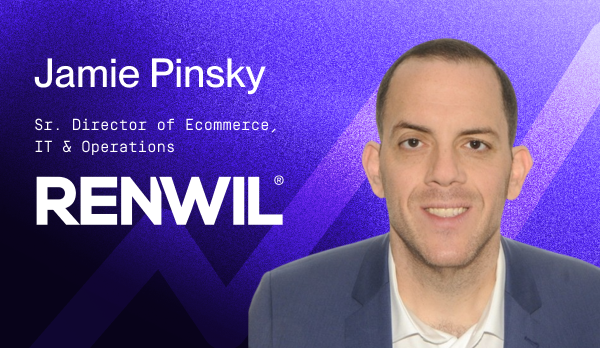
[00:00:00] Kailin Noivo: Welcome to another episode of The Ecommerce Toolbox: AI and Retail. Today's guest is Jamie, Senior Director of Ecomm and IT Operations over at Renwil. Welcome, Jamie.
[00:00:11] Jamie: Thank you. Thanks for having me.
[00:00:13] Kailin Noivo: Awesome. Jamie, we always like to start off by... Well, first off, you're a fellow Canadian, so welcome to the show. We're not too far away from each other. I'm in Ottawa, you're in Montreal. But why don't you tell us a bit about your career journey and how you ended up in your current role?
[00:00:27] Jamie: Yeah, thanks for having me. You know, love the podcast. Big fan. So I started off, you know, my first major job right out of school was Globe Electric. Started on the sales team as a sales coordinator. There was an opening on the ecomm team. I've always been a numbers guy, always been into tech, you know, growing up. I was the family IT guy, and it just kind of felt right. So I joined the team, and we had great success. Obviously, diving into the numbers, the ROAS, all that stuff. We took that from three million, and when I left, we were doing 30 million. We were the number three lighting vendor on Amazon. I got recruited to go to SCG Products, where I started the division from scratch. That's opening a 3PL, systems, infrastructure, all the way up. You know, I learned with a lot of these older companies, reporting and numbers are a focus, but no one knows how to really get them or look at them or have them live. So I taught myself SQL towards the end, built my own robust reporting, and then we scaled that division, also with licensing deals, to just over 30-odd million as well. And then I moved to Renwil about a year and a half ago. They already had a well-established drop ship program, but it's a more antiquated industry, very old school. Systems are very old here. I started with ecomm, and with that success, they gave me IT as well, seeing my tech side and, you know, my hunger to learn. And then operations: our senior person left, they saw my drive and how involved I am, and it was offered to me to take over that role as well, which includes sourcing, warehousing, replenishment, and forecasting. So I wear multiple hats.
[00:02:03] Kailin Noivo: That's cool, man. I really love the career journey, and obviously now your scope of responsibility has grown a lot. I'm curious, and a lot of our listeners are as well, about how people are implementing AI, right? On the operations side, the customer-facing side. So maybe starting off with a pretty broad question: where was the first place that you implemented AI, and how are you tactically bringing AI into your current role?
[00:02:32] Jamie: So when ChatGPT was getting mainstream a little over a year ago, our two owners were like, "Okay, guys, we know AI is gonna be a thing. How are we gonna use it at Renwil?" They asked us, "Before we fall behind, what can we do?" And everyone's so busy, and I took it upon myself: "Okay, let's look into it." I started researching, and I started small. I was feeding ChatGPT my SQL queries, and my reports were getting better and better. And then Claude Code came out, and I see all these Instagram videos and ads for what it can do. I installed it, I got a small taste, and the snowball was from there. I probably have 17, 18 sessions running at a time. I've built multiple apps since then. I started with what my smallest pain points were, what I could fix, and then it just spiraled from there: "Oh, can you do this? Oh, can we do this?" And people started seeing what it can do. And now that we have all this data, PD is making better decisions. We're more efficient. It just spiraled out of control from a couple of small problems that I was trying to fix myself.
[00:03:44] Kailin Noivo: Now, one of the earliest things that you mentioned is that leadership was bought into the idea. How did that come about? Did that just organically happen, or is that something that you or other folks had to influence?
[00:03:59] Jamie: Honestly, I think it was organic. They were seeing the ads; they're all over social media too. They were seeing what's happening. We also do a lot of trade shows. We're at High Point, we're at the Vegas market, and a lot of companies are trying to pitch AI images, AI PIMs, all these different tools people are trying to sell to us. So I guess it just kind of clicked: well, if all these companies are doing it, how can Renwil benefit from AI? It was very organic. We're a lean team. We try to do everything in-house as much as we can. They didn't wanna hire consultants, the Deloittes, all the big guys, because obviously we're trying to be as cost-effective as we can. So they asked us to research it and build our own plan, essentially.
[00:04:38] Kailin Noivo: Do you think it's possible for folks that don't have leadership buy-in to implement AI, like bottom-up? Or do you think that it's critical to have that buy-in?
[00:04:46] Jamie: I think so. Honestly, my tech stack is literally... I ended up buying a desktop, so not a big investment, and my Claude Max and my ChatGPT subscription. I pay no API costs. I built an entire infrastructure where I literally pay just my subscriptions, on the computer that they bought me. So I think you start small. If you build the right plan, you can really start from the bottom up and get huge buy-in when you show the results of just small projects.
[00:05:15] Kailin Noivo: Can you name one of the first agents that you've built that runs on a recurring basis, for reporting or something else, that goes all the way up to leadership?
[00:05:25] Jamie: Yeah. So it's the sales app. I call it Renwil Intelligence. When I first started here, they were doing sales reporting quarterly, not monthly, not weekly. And when the owners wanted a specific data point, it took a couple of days to run. Our system's antiquated. If you ran really big reports, it would crash the ERP. So I started building some small reports, and then when I found Claude Code, I was chatting through what I could do, and I built this full-blown sales web app. So every single day, I have multiple agents. Some of them are scanning all the data and syncing it to a local database on my computer, so I'm not bogging down the production database. And then overnight, they validate the data. Are there any drifts from what it's supposed to be? I know in the ERP database what the number is supposed to be, whether it's inventory, sales, open orders, transfers, AP, AR, all those different sections. I have agents that are syncing the data, and some are validating the data in my app against the ERP. If there's more than a 2% drift, I come in in the morning and I have a report: what drifted, why it drifted, what the fix is. And then it updates the local memory and my global memory so that drift doesn't happen again.
[00:06:44] Kailin Noivo: I love that. That's really, really cool. Most people are starting...
[00:06:49] Jamie: Sorry, to answer your previous question: one of the owners, literally in any meeting we go to, opens the app on his phone. Complete buy-in. He's texting me on the weekends, at 4:00 AM, "Okay, add this, add this." Once he got a taste of the numbers and the data he can see, I have carte blanche at this point. Whatever I wanna build or do, I have their complete buy-in for anything that Renwil needs from the AI perspective.
[00:07:17] Kailin Noivo: That's awesome. It probably feels like magic to the ownership, too. Out of curiosity, how did you actually deploy it so they have it on their phone? Because a lot of these things live inside, like, Claude. Did you have to build a separate app that this is actually porting into?
[00:07:32] Jamie: So how it all started is, one of the things I asked Claude at the beginning is: how can I keep the data secure? Because when you're using Claude Code or Codex, anytime you're using tokens, it's using their own APIs, and it flows through their servers. So the data is secure, but it lives on their servers. So I built a Flask Python API on my desktop, and that communicates with Claude or Codex internally, keeping all the data secure. Then, we're a Microsoft company, so I built an application in our Azure tenant. It's a self-hosted web app. So it works on our phones, it works on our computers, anywhere in the world. And from a security perspective, it's routed through a Cloudflare tunnel, and we're using Microsoft Entra ID to validate access. So only a Renwil employee is able to access the application.
[00:08:33] Kailin Noivo: Man, that's pretty sophisticated. Most retailers are going after customer-facing stuff: AI SEO, traffic, chatbots, things like that. You went the internal optimization route. Are you guys thinking of anything customer-facing? I know that you're more of a B2B shop, but are you thinking of any different applications on your site or the B2B portal? Have you started playing there at all?
[00:09:01] Jamie: So we have. The first part was to get our operational side, you know, clean data, everything operationally sound on our side. Then we're looking to implement a chatbot that I'm currently building. So if you need a tracking number, invoice information, specs, anything, you can ask on the website. We moved to Shopify in January, so from a portal perspective, Shopify has been great for us. Not many tweaks there, but it's more 3D image generation, more on the GenAI side of things. We're looking to use it more and more to generate better content and a better experience, and also to find bugs within Shopify itself. We have a custom theme; the whole store is custom. Just using those tools to make it as efficient as possible.
[00:09:46] Kailin Noivo: That's cool. Is there anything that you've tried to build but abandoned because it was too hard?
[00:09:53] Jamie: Yeah. So like most companies, we started using different AI tools to generate images. Due to the seasonality and how we work with our product launches, we have to pre-buy a lot of credits with those companies, so it gets pretty expensive. So I wanted to build my own internal image gen tool that was trained on the Renwil look, the Renwil pieces. I have a consumer GPU in my desktop, so obviously I don't have a $100,000 H100 where I can do everything. So using RunPod, I rented some serious cloud GPUs to try and train a model. I spent weeks and weeks and weeks, but I could never get it to a quality that we would be happy with. And you're testing different models. OpenAI had their new image gen model come out, and it worked wonderfully, but I couldn't train it on the Renwil look. So that project I had to abandon, just because I could never get it to the quality that I knew our marketing team and our owners would allow to be deployed. So that was one of my biggest failures here that I've abandoned and given up on.
[00:10:58] Kailin Noivo: Yeah, makes sense. That's obviously a hard space to compete in as well. And to your point, at some point you have to get back to doing what you guys do. But it's interesting: a lot of the analytics use cases you mentioned, consistent visibility, daily dashboards, are obviously things AI is really good at. What's next, top of mind for you? Something our folks are thinking about too is where to buy versus build. Obviously, you didn't try to build Shopify, right? You implemented Shopify. But there's a whole bunch of stuff that you're building yourself. What's next in the build-versus-buy category for you guys, out of curiosity?
[00:11:43] Jamie: So it's gonna be our PIM. Right now we're using Salsify as our PIM. It's great, but it's expensive. We're paying a lot of money for this great tool, and we're not using all that it can do. So right now we're slowly building our own PIM. It's gonna be fully custom-built in-house. Someone on my team manages all of our data architecture and our different systems, and we're already in progress. That's our biggest thing. It's gonna be more agentic-focused, using a lot more AI within the application, and just making sure our data is structured and ready for GEO and agentic search, making sure it's prepped for what's coming versus what's now.
[00:12:27] Kailin Noivo: That's cool. I'm curious how far you guys get on that, because obviously there's a whole bunch of PIM companies. Trying to understand where people are gonna build versus buy long-term is gonna be really interesting. Talk to me a bit about the channel side. Obviously, a lot of your sales happen on other people's websites. Have you been able to bring any clarity to that, that you may not have had before, with some of the agentic systems that you built?
[00:13:01] Jamie: Yeah. So we sell to 4,000 different retailers across North America, from small independent retailers, designers, and stagers all the way up to the major retailers. And one of the biggest things is inconsistency across all the different sites. We may feed everyone our data, but are people uploading it properly? Are the images all there? So we're using different scrapers to check the number of images. Are all the images correct? Do we have all the right content? Is the product being displayed properly? And then the number one, obviously, is MAP enforcement. We have a very strict MAP policy. I was being pushed and pushed, and I onboarded a MAP tool earlier in the year. It's been great, but it needs a lot of work, and it's also on my list to rebuild for next year. Instead of having my team comb every single site for 2,000 products, which would mean hiring someone full-time, we have agents running on a monthly schedule that check almost 2,000 websites for all these different points. Are all the products in stock? Are the right products there? Have discontinued products been taken offline? Just to make sure that the Renwil image that's customer-facing on all these sites is what it's supposed to be, to the owners' expectations.
[00:14:23] Kailin Noivo: That's interesting. Have you guys had any issues with unauthorized selling?
[00:14:29] Jamie: So we're not a big Amazon shop here. At my previous company, SCG Products, we had a massive unauthorized retailer problem that cost us millions of dollars. Before, we'd have to have someone on the team check every single buy box every single day: who has it, who doesn't have it. We used Amazon Transparency. And now, if I needed to, I could just have a couple of agents scan it every 10 or 20 minutes to tell me, "You have the buy box. You lost it. Who has it? How much inventory do they have?" The amount of time it would save us now would be incredible. You wouldn't need a person to do it anymore. I would have the whole thing automated.
[00:15:08] Kailin Noivo: Out of curiosity, are you guys using frontier model tokens for most of this, or are you using open source models?
[00:15:17] Jamie: For the most part, we're using the frontier models, so Claude Code, Claude, and obviously ChatGPT are my number one and two. I am testing a bunch of local models. I have a couple of the Qwens, MiniMax, a couple of different ones I use when I have to do some really heavy lifting. For example, I did a freight analysis where I had to OCR 8,000 invoices over the weekend. I had the open source one tackle that. It's all local, secure, all on my computer, versus burning millions of tokens to do that.
[00:15:51] Kailin Noivo: Okay. That's really, really interesting, because it sounds like you guys are fully in build-everything mode. And with certain things, the cost of tokens can get pretty expensive, especially on an ongoing basis. So I'd be curious to see if you move more and more token consumption to open source models over time, especially for recurring tasks.
[00:16:15] Jamie: So one of the things I've actually been able to avoid is, I pay zero in API tokens. Everything is through subscriptions. I found a couple of authentication proxies for Claude and for ChatGPT, where basically anytime they would use an API, it routes to my subscription, be it for agents, be it for anything. So I have a Claude Max and a ChatGPT Business subscription, and I've never had to pay a dollar more than those subscriptions for anything I've done here, on the billions of tokens that I've used.
[00:16:47] Kailin Noivo: I love that. Very efficient. In the next 18 months, Jamie, where do you see this heading when it comes to building agents? How prevalent are agents gonna be? Are we still gonna be hiring people in commerce? You're obviously on the bleeding edge of this. How are you thinking about it?
[00:17:11] Jamie: I don't think it's gonna replace humans. I think we're gonna be the agent managers at some point. I think about my team: in the next 18 months, I'll still have to hire a human or two. I just think we're gonna be very, very efficient people. We're gonna use agents for a lot of basic, repeatable tasks. We're making skills for a lot of these things, and we still need a human in the loop. Someone needs to verify the work. Obviously, it's not perfect. Even if I have agents doing the work and then checking the work, I still check in and make sure everything is correct. So to answer your question, I just think we'll be using more agents to make us more efficient. Will we have to hire more and more? No. But we still need humans.
[00:17:57] Kailin Noivo: Yeah. I think people will have direct reports that are humans and agents. And some people will have a lot of agent direct reports. It'll be interesting.
[00:18:13] Jamie: A hundred percent. I built my own AI operating system. I have like 40 different agents for every single thing I do. But I still have, on the ecomm side, a team of four people. I still need people to do certain work or to manage certain things. One of our failures here is that our ERP is so antiquated, I tried to have agents do the work in the ERP, and it kept crashing. It just didn't work. So with my current tech stack, I can't replace humans. Obviously, we're shopping for a new ERP. We've selected one, and our go-live is July 2027. Even in the new system, as automated as it can be, I don't see myself replacing my current team with agents anytime soon.
[00:18:59] Kailin Noivo: Did you guys consider building your own ERP?
[00:19:03] Jamie: So the joke was actually made, to ask if we should. I asked Claude, and it told me not to. If anything, we'd take an open source one and build on it, but that would be more than me being able to do it on the side or as part of my responsibilities. I'd have to hire someone full-time to take care of it, and it's so intertwined with the business. We own our own warehouse, and we have so many different facets and parts of the business. We're importing from eight different countries. We're shipping across North America and internationally. I think it would just be a lot more work to build it, so this is one of the things we're gonna buy versus build.
[00:19:44] Kailin Noivo: What I'm curious about is, as time goes on, how are people gonna make that decision about what they're buying versus building? What is your mental model for that?
[00:19:57] Jamie: For right now, for most things, I'm on the build side, because we have a simple business. We don't do anything complicated, so I don't need very complicated systems. Even a CRM: I could get by with Monday or ClickUp, but I built my own. I found an open source version, did my own spin on it, and it's built for what we need. But as more and more of this build-versus-buy conversation happens, people are gonna be building cheaper and cheaper versions as AI gets better and better. I think it's gonna come to a point where the cost to buy might be inexpensive compared to building it from a token perspective, because it's gonna force all the big guys to reduce their prices, and it's gonna force the cost down to a point where it may not make sense to build anymore. But for now, I think it makes sense to build, depending on whether you have the infrastructure, the buy-in from management, and the time and the resources. And because there are so many choices now, how do you pick what's best for your business?
[00:21:02] Kailin Noivo: It's true. I think at least give it a try, and if you can't do it in a few hours, then you can't do it. Cool. Jamie, this was an awesome episode. Thank you so much for hopping on. Really appreciate your time. This was really, really helpful.
[00:21:17] Jamie: Thanks for having me.
[00:21:18] Kailin Noivo: Awesome. Thanks, Jamie.
[00:21:20] Jamie: Thank you.
FAQ
Other episodes



.png)
.png)
.png)
.png)
.png)

.png)
.png)
.avif)
.avif)
.avif)
.avif)
.avif)
.avif)

.avif)
.avif)
.avif)
.avif)
.avif)
.avif)

.avif)

.avif)
.avif)
.png)
.avif)
.avif)
.avif)

.avif)
.avif)
.avif)
.avif)
.avif)
.avif)
.avif)
.avif)
.avif)
.avif)
.avif)
.avif)
.avif)
.avif)
.avif)
.avif)
.avif)
.avif)
.avif)
.avif)
.avif)
.avif)
.avif)
.avif)
.avif)
.avif)
.avif)
.avif)
.avif)
.avif)
.avif)
.avif)
.avif)
.avif)
.avif)
.avif)
.avif)

.avif)
.avif)
.avif)
.avif)
.avif)
.avif)
.avif)
.avif)
.avif)
.avif)
.avif)
.avif)
.avif)
.avif)
.avif)
.avif)
.avif)
.avif)
.avif)
.avif)
Audit your site today
Understand the revenue impact of all errors on your site and how to swiftly reproduce and resolve.