
Expert Perspectives
Expert Perspectives
Episode 127
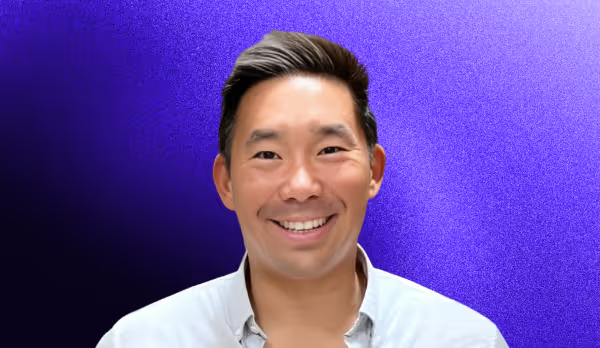

In this episode we talked about:
- How fulfillment is evolving from an operational function into a strategic growth lever
- Why marketing decisions often create hidden operational constraints
- How fulfillment partners can enable new revenue opportunities
- When it makes sense to move from in-house to outsourced fulfillment
- Why unpredictable demand requires more flexible fulfillment systems
- How late retail purchase orders are changing inventory planning
- What returns data can reveal about product and customer behavior
- Why adaptability is becoming a key factor in partner selection
🎧 Listen now on Apple Podcasts, Spotify, or YouTube

Episode highlights:
06:30 – The role of AI in fulfillment optimization
08:00 – Shipping expectations and cost trade-offs
09:30 – Planning for unpredictable demand and viral spikes
10:50 – Retail trends and delayed purchase orders
12:30 – When to outsource fulfillment
16:30 – Why adaptability matters in fulfillment partnerships
Brian's bottom line: The brands that scale fastest aren't necessarily the ones with the best products; they're the ones who built the right operational foundation early. Start by fulfilling in-house so you understand your own complexity, then outsource to a partner who treats your business like their own. And whoever you partner with — 3PL, agency, or tech vendor — make sure they can adapt as fast as you do. In a market where POs shift mid-peak and demand can triple overnight, rigidity is a liability.
Brian Tu — Transcript
The Ecommerce Toolbox: Expert Perspectives • Human-Reviewed Transcript
[00:00:00] Brian Tu: You have to proactively work with your customers and, like, understanding their forecast, understanding where their business is going. But at the same time, sometimes you can't predict demand. Like, in some cases, customers explode, and you have to kind of be able to kinda scale quickly and pivot to those needs. Like, sometimes, like, things go viral, and you're obviously, your volume increases 3x overnight.
[00:00:25] Kailin Noivo: On today's episode, we're gonna go through a lot of really interesting things with Brian. We talked a bit about 3PL, how it's integrating AI, when you should actually start with a 3PL company, when you're scaling in revenue, and how you can actually pick the right partner. So, if you continue to double or triple your sales year over year, you're not gonna be operationally constrained. Super excited for today's episode.
[00:00:45] Kailin Noivo: Welcome to another episode of The Ecommerce Toolbox Expert's perspective. Joining us today, we have Brian Tu, who's the CRO of DCL Logistics. Welcome, Brian.
[00:00:55] Brian Tu: Thank you for having me. I'm excited to be here.
[00:00:58] Kailin Noivo: Awesome. So, we're really excited for this episode today. Maybe talk us through your career journey and how you ended up in your current role.
[00:01:05] Brian Tu: Actually, I spent about 18 years in adtech, so really working with Fortune 500 companies to place ads and do digital marketing, so really working for them to reach the audience. Early days of digital marketing, and kind of fast forward to kinda 7 years ago. I joined DCL, and I'm the CRO. If you kinda do a little research, we're a family-owned business. My parents started it 43 years ago, so I run the company with my brother. My parents have since retired.
[00:01:38] Kailin Noivo: Very cool. Just out of curiosity, how'd your parents get in the business, and, like, how has that kind of evolved over the years? Obviously, there was a big D2C boom in COVID. Maybe start us off with how your parents kinda launched the business, and then we'll go for how it's evolved.
[00:01:50] Brian Tu: My parents started in 1982 in Silicon Valley, so back in the day where Internet didn't exist. And they started off. My father worked at Hewlett-Packard as a programmer, and he decided, hey, listen. I wanna start my own business, and he stumbled across kind of diskette duplication. So, for those that are probably dating myself here, but back in the day, when there wasn't any kind of digital software, you had to buy physical software. So, we did diskette duplication and replicated those diskettes from kind of software companies millions of times over. We packaged them up and delivered them to the store. So, we did that for a good 25 years. And then as the Internet kind of exploded, my father said, hey, listen, this thing called the Internet, people aren't gonna buy physical software anymore. They're gonna download it. So, he pivoted away from kind of duplicating software, and he says, hey, well, we're good at kind of retail fulfillment. Why don't we become a kind of full-service fulfillment company? So, we went from retail fulfillment and expanding into direct-to-consumer.
[00:02:56] Kailin Noivo: That's really, really cool. So, that's kinda crazy because the industry you're in now didn't exist when your parents, like, started, which is kinda crazy. So, they had to full-blown, like, pivot into it. Obviously, it's adjacent. You obviously spend time selling software. Maybe talk a bit about what's the biggest shift in kind of your mental models when it comes to software and digital outcomes versus, like, fulfillment? Like, what's the core value prop of fulfillment, and how is it fundamentally different from, like, martech, for example?
[00:03:24] Brian Tu: That's a good question. I think with software, it's obviously infinitely scalable, and that's why SaaS is, there's trillion dollar companies out there selling software and digital media, so it's infinitely scalable, where fulfillment, obviously, there are constraints. There's physical constraints. So, you're selling physical goods and physical services. So, that's been, like, the real transition in terms of, like, I get an infinite amount of stuff to sell. And now you have to be a lot more kind of thoughtful with kind of how you're servicing brands, the new brands you're selling to, and making sure that the right fit could be for the services that you provide because there are constraints.
[00:04:00] Kailin Noivo: Very cool. From there, talk a bit about DCL's January 2026 expansion.
[00:04:06] Brian Tu: We're adding our seventh facility in the U.S. We're adding another facility in Southern California, so it'll be our third facility in Southern California. And we actually purchased the building, so we own and operate all of our facilities. We own the facilities. We own the land. And we've seen this kind of explosion over the last kind of, let's say, decade in terms of just omnichannel fulfillment demand. So, it went from retail to, obviously, D2C exploded during the pandemic. And our Southern California facility has seen that demand surge just because of more products coming in from the ports. It's a great key in us staging point for a lot of kinds of retail and omnichannel fulfillment, both retail and direct to consumer. So, we wanted to make sure we stayed ahead of our customers' growth and opened a brand new facility. So, we're actually opening that in June of this year, so super excited.
[00:04:58] Kailin Noivo: Very cool. So, obviously, our listener base is heavily just retailers that are trying to get an edge. What are some of the edges that you think people need to get in fulfillment? Like, if I'm a D2C brand, what's the edge I can get over my competitors with partnering with a company like yours?
[00:05:15] Brian Tu: I think, really, with fulfillment companies, it comes down to, like, a true partnership. There are obviously a lot. They see a lot in terms of the floor, what other brands are doing, kind of best practices, and also making sure that the fulfillment providers can kinda unlock different capabilities. Like, examples of, like, their software should be dynamic enough to kind of help expand sales. I'll give you an example of something like virtual bundles. So, a marketing team wants to kind of test new products or bundles of products. But there are constraints on the operation side, so we built software that you can set up virtual bundles and kit them on the line, as opposed to kind of locking up your inventory by pre-kitting it, as an example. So, there's different ways to kind of work with your fulfillment provider to really unlock kind of either different sales channels or increase average order value by using different softwares or kind of in-house expertise.
[00:06:14] Midroll: If you're listening to The Ecommerce Toolbox, you're entitled to a podcast exclusive website audit. Go to noibu.com/podcast-audit for a free scan that uncovers the hidden friction blocking your conversions and shows you where you're leaking revenue.
[00:06:27] Kailin Noivo: Very cool. Talk to me a bit about, you'd mentioned you guys are building some software for things like that. Is AI impacting your business at all, like, either internally, operationally, or how you're interacting with your clients? If so, talk to us a bit about that.
[00:06:40] Brian Tu: For sure. AI is definitely impacting our business in a good way. It's driving efficiencies. One specific way is last year, we launched kind of an AI-powered carrier and parcel optimization engine. And what that really means is, like, taking all this kind of disparate data and allowing AI to make the decisions on behalf of ourselves and on behalf of our brands to kind of drive kind of cost down from a parcel standpoint and increase transit speed. So, you think about kind of millions of data points. It's really hard to kind of process that on spreadsheets. It's really slow, and this is purpose-built for kind of this generation of, like, AI-powered thinking and in real time optimization. So, that's something that we actually applied today, and it's been a it's been a huge success in a very short period of time.
[00:07:30] Kailin Noivo: Very cool. Now getting into some of the ecom-specific things. So, we're chatting about this before, but McKinsey company did a report. 95% of consumers say that they actually prefer free standard shipping over paid expedited, and more than 80% will still buy if there's 4 to 7-day delivery when it's free. When brands want kind of two-day everywhere, how do you actually help them build infrastructure to be able to deliver on that? And what's, kind of, some of the maybe hidden costs to serve when it comes to being able to enable that?
[00:08:04] Brian Tu: I think that our brands could, our customers could have both. A lot of brands could have both. They could have faster delivery, and that's cost-effective. So, I believe that they could have both. So, working with brands up front is really understanding kind of their order profile, where the customer base is, and deciding how to place them in your network, whether it's two nodes that are bicoastal or it's a single node in the middle of the country. It really depends. The beauty of it is that the carrier infrastructure or carriers have expanded tremendously over the last fifteen years. So, fifteen years ago is, like three main carriers, UPS, FedEx, and USPS, and now there's dozens of carriers to choose from. So, it really kind of opened up the market for options and using technology to tap into those various carriers and then kind of, again, like I said, bringing costs down, while increasing or maintaining kind of fast shipping.
[00:09:01] Kailin Noivo: Makes sense. I believe our team looked at one of your case studies. It talked about one of the brands that you guys support, tripling their sales year over year. How have you guys kind of built infrastructure to be able to, like, support that so that quality doesn't instantly drop? Like, how do you guys do you guys, like, kind of forecast who's gonna grow or just have kinda latent demand? I'm curious how you guys handle things like that.
[00:09:25] Brian Tu: It's kind of ballpark. I think we it's like you have to proactively work with your customers and, like, understanding their forecast, understanding where their business is going with sales channels they're really, like, leaning into over the next 18 months, and then it's on us to kind of plan for that and making sure that we have the infrastructure, not only physical infrastructure, but we have the technology to kind of support kind of that growth. But at the same time, sometimes you can't predict demand. Like, in some cases, customers explode, and you have to kind of be able to scale quickly and pivot to those needs. So, we've created kind of a platform, if you will, both like a physical platform and infrastructure to scale quickly based off just surges and spikes. And this is becoming more common, obviously, with the popularity of different sales channels like TikTok. Like, sometimes, like, things go viral, and you're obviously your volume increases 3x overnight, opposed to average, and it was totally kind of out of left field. So, you have to be able to kind of adapt to your customers' kind of needs in different sales channels.
[00:10:31] Kailin Noivo: Makes a ton of sense. When you're doing your kind of planning with your customers this year, what were some of the biggest kinds of themes that you saw across the customers that maybe you could pull as an insight when it comes to specifically retail businesses?
[00:10:44] Brian Tu: I think some themes that we saw, and this is kind of the tailwinds of kind of tariffs and things of that nature. And, like, so we saw kind of inventory constraints. So, we saw a lot of our customers kind of actually lead into kind of the hero SKUs. So, maybe kind of tighten up their kind of SKU catalog or item catalog and focus on kind of, like, the fast-moving SKUs or maybe the higher margin SKUs. So, that's one thing that we saw, and that kind of translated into retail. The other thing that we saw is that retail, actually, this year or last year, 2025, was much later in the year, meaning POs were dropping far later than in my previous 10 years. And I think that, obviously, retailers are holding back on POs. So, you had to quickly adapt to say, okay, there are massive POs dropping in the middle of peak, which we had never seen before. So, we were kind of forecasting that, and we had to make sure we had to plan accordingly because it takes space, it takes manpower to do retail. So, we had to kind of adjust quickly and make sure that we're kind of ahead of that. I think the same will be in 2026 as there's obviously a lot of kind of macroeconomics in play. Fuel costs are going up. The cost of goods is going up. So, customers are thinking about their bottom line of saying, okay, do I tighten up my SKU account even more? Do I tighten up my sales channels? And are retailers gonna buy later in the year, and how do I kind of play an inventory around that?
[00:12:14] Kailin Noivo: Makes a ton of sense. What kind of business scale? Is it revenue, number of SKUs? Does it start to make sense to actually take your fulfillment from in-house to a third-party provider?
[00:12:25] Brian Tu: It's a great question. It really depends, and it's not like I don't wanna give you a non-answer. I think if in-house fulfillment becomes, like, a distraction, like, again, I always think about brands. Like, their core focus is building amazing products and selling those amazing products. And if warehousing and the management of fulfillment becomes a distraction and it becomes just, like, just overhead, it's a no-brainer for me in the sense of, like, you should outsource it. Like, you should focus on what you're great at. On the fulfillment side, we focus on fulfillment. We don't get distracted by other things, and we say, okay, we wanna be great at one thing, and this is what we're gonna be great at.
[00:13:07] Kailin Noivo: Makes sense. Is there, like, a revenue scale that kind of starts to become more apparent in your experience, or is it really like it could range anywhere from a million to, like, 20 or 50?
[00:13:17] Brian Tu: That's a good question. I would say if you think past a million, like, it's a no-brainer. Obviously, there are so many auctions out there now, and the hurdle to get into, like, work with a third-party fulfillment provider is that the bar is so much lower now in terms of just the barrier to entry; it's very turnkey. I think that it is important for brands sometimes to fulfil their own product because they're gonna iterate quicker. Like, they're gonna understand why customers are returning the product, or they're gonna say, okay, the design of this package isn't really hard to do. It's gonna cost me a lot to actually fulfil it. Maybe writing a handwritten note on every package is not a scalable solution. It might look nice in marketing, but it's gonna cost you a lot of money down the road. So, those are the little things that I always think about, is how nuanced is your fulfillment profile, but also, it's important that they have hands-on initially to kind of learn. And then once they kind of outsource it, they could kind of help guide the 3PL, and you could help scale your business quicker that way.
[00:14:14] Kailin Noivo: Makes sense. There's been a lot of headlines around returns being just like a macro problem, right? So, maybe talk to me a bit about returns. How do you guys kind of help with that? That seems like, honestly, it's a sticky problem with some brands, like having up to, like, 20% of their sales being returned back. So, talk to me a bit about that.
[00:14:35] Brian Tu: As a consumer myself, it's like you just assume that the brand, you could return the product, and you could try it before you buy it, type of thing. So, we see that super common. And, obviously, big guys like Amazon have, like, just made the return process so easy, so that's kind of habituating the consumer's kind of mindset. I think on the brand side, it's really important that, one, they have clear kind of return rules, what you can and can't return. Two is making sure that kind of the business rules with the fulfillment provider are very buttoned up in terms of what to do with inventory, what it gets back. The sooner you, like, as of you disposition is it's a good product, can I put it right back into a good stock and sell that product? The other thing is, if it's a disposition for kind of recycling, make sure those business rules are really clear. So, at the same time, you want the platform and the information to provide back to kind of the brand in real time. So, you could provide it to marketing. You could provide it to sales channels, the supply chain teams of why these products are being returned, so they could iterate and learn faster.
[00:15:40] Kailin Noivo: Very, very cool. Makes a ton of sense. As we look to wrap up, Brian, is there anything else that you want our listeners, who are mainly retailers, to kind of think about?
[00:15:49] Brian Tu: I think it's we know this world, this space, it's like ever changing, so kind of having that kind of flexible mindset and adapting to the market. And your partner should act no differently. So, whoever you partner with, like, for example, a 3PL partner, should have that same mindset, that adaptability is gonna help you scale your business. And you wanna make sure when talking to 3PLs or any partner that they share that same mindset. So, it's not just a vendor. It's really a partner mindset. And that's more so than ever before, just because of kind of what's going on in the world, how it's changing, I feel like, every single day. And brands are just kind of adjusting on the fly, and partners need to do the same.
[00:16:29] Kailin Noivo: Very cool. Thanks, Brian. If someone wants to get in touch with you, how can they do that? Maybe LinkedIn. Is that a good channel for you?
[00:16:35] Brian Tu: Yeah. LinkedIn. Please find me, briantu on LinkedIn or find me on the website, dclcorp.com.
[00:16:41] Kailin Noivo: Awesome. Thanks so much, Brian.
[00:16:43] Brian Tu: Hey. Thanks for having me. Appreciate it.
[00:16:46] Outro: The Ecommerce Toolbox Expert Perspectives is brought to you by Noibu. To learn more about Noibu and how we can help you debug your ecommerce site and rocket your revenue, visit www.noibu.com. That's n-o-i-b-u.com. And then make sure to search for The Ecommerce Toolbox Expert Perspectives on Apple Podcasts, Spotify, or anywhere else podcasts are found, and click subscribe so you don't miss out on any future episodes. On behalf of the team here at Noibu, thanks for listening.
FAQ
Other episodes


.png)
.png)
.png)
.png)
.png)

.png)
.png)
.avif)
.avif)
.avif)
.avif)
.avif)
.avif)
.avif)
.avif)
.avif)
.avif)
.avif)
.avif)

.avif)
.avif)
.avif)
.png)
.avif)
.avif)
.avif)
.avif)
.avif)
.avif)
.avif)
.avif)
.avif)
.avif)
.avif)
.avif)
.avif)
.avif)
.avif)
.avif)
.avif)
.avif)
.avif)
.avif)
.avif)
.avif)
.avif)
.avif)
.avif)
.avif)
.avif)
.avif)
.avif)
.avif)
.avif)
.avif)
.avif)
.avif)
.avif)
.avif)
.avif)
.avif)
.avif)
.avif)

.avif)
.avif)
.avif)
.avif)
.avif)
.avif)
.avif)
.avif)
.avif)
.avif)
.avif)
.avif)
.avif)
.avif)
.avif)
.avif)
.avif)
.avif)
.avif)
Audit your site today
Understand the revenue impact of all errors on your site and how to swiftly reproduce and resolve.