
Expert Perspectives
Expert Perspectives
Episode 131
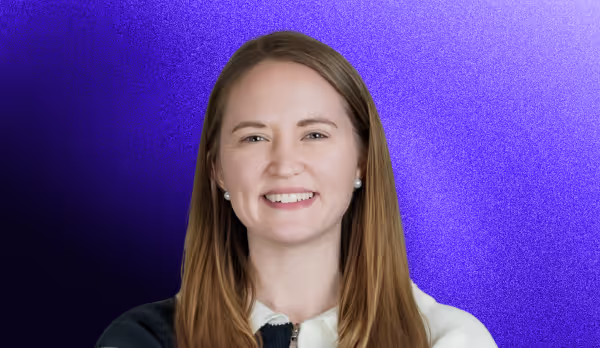

In this episode we talked about:
- How to differentiate product assortments between direct channels and marketplaces
- Why marketplace search data is a powerful tool for product development
- How global procurement programs can streamline international expansion
- Why pricing discipline is vital for maintaining healthy retail partnerships
- How to identify and mitigate gray market and unauthorized seller issues
- How to use AI to increase creative velocity for product page testing
- Why understanding distinct consumer profiles is essential for setting performance expectations
- How to harmonize data across different digital channels
🎧 Listen now on Apple Podcasts, Spotify, or YouTube

Episode highlights:
4:30 - Leveraging Amazon search data for product insights
7:58 - Streamlining global expansion with the GPE program
12:15 - Maintaining pricing discipline and assortment strategy
13:58 - Strategies for gray market and unauthorized seller enforcement
16:51 - Navigating the differences between DTC and Amazon performance
Rachael's Bottom Line: Marketplaces aren't just a revenue channel, they're a real-time map of consumer intent, and the brands winning here feed that signal back into product, assortment, and merchandising rather than treating Amazon as a separate P&L.
Rachael Jemetz — Transcript
The Ecommerce Toolbox: Expert Perspectives • Human-Reviewed Transcript
[00:00:00] Rachael Jemetz: Marketplaces like Amazon are essentially a real-time map of consumer intent. You can see exactly how people think, what they're looking for, and how that shifts over time. It's not just about driving performance, but it's also about spotting trends and identifying opportunities and product mix.
[00:00:15] Kailin Noivo: Super excited for our podcast today with Rachael. We talk everything marketplace and how to work in a harmonious state with your D2C counterpart. So, really, really interesting episodes. Obviously, she works at a super iconic brand called PopSockets. Everyone kind of heard of them at one point or another, so really excited for today's episode.
[00:00:35] Kailin Noivo: Welcome to another episode of The Ecommerce Toolbox Expert's Perspectives. Joining us today, we have Rachael Jemetz. She is the director of global marketplaces at PopSockets. So welcome, Rachael.
[00:00:46] Rachael Jemetz: Thank you for having me. It's an honor.
[00:00:47] Kailin Noivo: Awesome. We were chatting before. I had your colleague, Jack, on about a year ago, so excited to get a slightly different perspective on a similar business. But what we really wanted to talk a bit about today was a lot about marketplaces and how marketplaces and D2C work as one system and not separate P&Ls, kind of fighting for attribution, although I'm sure that doesn't happen for you guys. So, maybe why don't you kick us off with telling us a bit about your career journey, how you ended up in your role, and, yeah, your background.
[00:01:17] Rachael Jemetz: I'll start with my current role at PopSockets. I'm very fortunate to work with an incredible team and a playful product. A product that is especially fun for me because I was a user and had a genuine love for PopSockets long before I joined the company, so particularly fun one. I've been in the marketplaces space now for about 8 years. I got started at a non-fiction publishing house named Callisto Media. And this is where I became really interested in language and how consumers choose what to search for, which is what Amazon and marketplaces in general boil down to. So, that curiosity naturally translated into ecommerce. Marketplaces like Amazon are essentially a real-time map of consumer intent. You can see exactly how people think, what they're looking for, and how that shifts over time. So, I gravitated towards that because it's not just about driving performance, but it's also about spotting trends and identifying opportunities and product mix. So, that combination of language, data, and behavior has really kept me hooked in the marketplaces space.
[00:02:25] Kailin Noivo: Very cool. And when I chatted with Jack about a year ago, he was telling us a bit about how PopSockets really evolved from being, like, a single product SKU company to more of, like, a mobile lifestyle brand. I remember being really, really, really impressed. So, you guys are obviously doing weekly drops, some niche, subculture stuff that you're jumping on in 70-plus countries. From a marketplace standpoint, like, how are you keeping up with such a diverse product catalog? And, yeah, like, how does that translate to operational complexity? I know a lot of the ecom platforms themselves are built to be able to handle this, but talk to me a bit about it from the marketplace side.
[00:03:01] Rachael Jemetz: Yeah. So, each channel is unique, and we really treat them as such. Popsockets.com is treated as the beacon of the brand. So, anything new, exciting, and exclusive will be found on .com. But if you're shopping on Best Buy, you'll see a far more tech-focused product line. And on Amazon, in marketplaces widely, we sell products with the most mass appeal. So, when it comes to introducing new products on marketplaces in this constant weekly or more rotation of collection drops, we take a part proactive, part reactive approach. The proactive side takes these product collections and breaks them down into individual products that roll up to common keywords. So, maybe on .com, we're launching a festival collection with 20 products in it, but on Amazon, we see 5 products with opportunity and keyword traffic. So, we take one pink grip, one sparkly wallet, two rainbow grips, and a floral phone case, and we leave the other 15. So, when these products launch on .com, they launch simultaneously on Amazon. We just don't introduce them as a collection. Amazon tends to be more individual product-focused. So, that's the proactive side. On the reactive side of the other 15 products, if one or two of them end up doing really, really well on .com, then we'll introduce it on marketplaces in the coming weeks or months.
[00:04:37] Kailin Noivo: Very cool. Most brands that I talk to, they typically segment their Amazon data from their D2C data. So, talk to me a bit about how you guys are looking at that, like, from search rank to conversion rate. And how are you guys thinking about the D2C experience versus, like, the Amazon experience or the marketplace experience from an analytics standpoint?
[00:04:56] Rachael Jemetz: Yeah. So, there's a lot of overlapping data and insights we can get across the two platforms. I think Amazon is different in two major ways. One is through product page testing. It's just a lot more rigorous on Amazon. And then, through search term data, testing is pretty straightforward. Amazon has the A/B testing tool that we use and abuse, and it's great for determining what product page content really helps consumers convert best. On search term data, though, Amazon really spoils us with keyword data. Both what is being searched in all of Amazon and what is being searched to directly find and convert on our products. So, it helps us really figure out how customers are talking about our products and the terms they use. We call it MagSafe, but what do they call it? We introduce a product, and we call it putty, but they call it pink. So, this helps us find the best terms to put on our product pages to make sure we're indexing against the right terms, and it helps us find gaps in product selection and design into them. So, a fun example is last year, 34,000 people searched for Snoopy or Peanuts PopSockets, and we didn't have a collection. So, in February, we just launched actually our third Peanuts collection, and that licensor is doing phenomenally well. So, all of that data is super valuable to really help assess assortment plans, align with what our customers are really seeking.
[00:06:26] Kailin Noivo: Very cool. Do you, like, think of harmonizing the data between D2C and then channels to try and develop, like, an overall signal, or is it very much kind of, like, bifurcated between channels?
[00:06:35] Rachael Jemetz: Yeah. It depends on the data type. We overlap a lot of our data, like sales data, product data, and conversion data. Traffic data, though, is analyzed separately. I think whenever we look at .com traffic data, you already have to be on .com to be then searching. On Amazon, you already have to be on Amazon to be searching, but it's the combination of total searches and just PopSocket searches. So dashboard ended up being different.
[00:07:04] Kailin Noivo: Very cool. Yeah. We chatted a bit about this already, but do you have any other examples of how you're able to leverage some of your marketplace data to inform a collection? I know you just chatted about, like, the peanuts. Is this, like, pretty common practice for you guys?
[00:07:20] Rachael Jemetz: Yes and no. We have our fair share of product collections that are informed by search trends. But we have plenty of collections that have no search data backing whatsoever. It's, you know, PopSockets is the category pioneer of the phone grip. So, it's in PopSockets' DNA to be unexpected, delightful, and innovative, not just to give the consumer what they're already seeking.
[00:07:45] Kailin Noivo: PopSockets' operating across a ton of different channels, a ton of different countries, how are you deciding what markets to enter? Right? So, for example, like, if you wanna enter Amazon Portugal, how are you making those decisions? Like, seems kind of random. You know what I mean?
[00:08:04] Rachael Jemetz: Yeah. Amazon Portugal is not available right now, which is why we're not in Amazon Portugal. But as it relates to Amazon, this is actually a really fun one. So, it's an 18-month project now that's finally coming to a head. The Amazon released a beta program named GPE or Global Procurement Excellence. It's super fun, and it's really helped us streamline access to Amazon markets globally. So, the GPE program includes all available Amazon markets outside of India and Brazil that are just a little bit harder to get into right now, but hopefully, there's a future where the GPE program includes India and Brazil. So, this program places orders. It operates from a central team that sits in the U.S, sits in Seattle, and it places orders directly from our factories in Vietnam, Thailand, or China, picks up locally and then takes that inventory and disperses it out to the 19 different countries that are participating in the program. So, where previously we had localized fulfilment in Europe, and Japan, and Mexico, now we were able to consolidate everything to, if the country participates in this GPE program, then we can access that Amazon country and supply inventory to it really, really easily. That's been a huge operational streamlining for us in a major program that we're really, really just getting into the sell-through operations for now.
[00:09:39] Kailin Noivo: That's really, really cool.
[00:09:41] Rachael Jemetz: Yeah. Yeah. Really cool one. And really proud of the team in the long project to hard work it's taken to get here. Outside of Amazon, though, it really depends on the dominant marketplace in the country and what is important to the shoppers in that country. So, in Japan, it's Rakuten. Over Amazon, in the Philippines and India, it's Shopee. So, we look at what marketplace is dominant in that country and then compare it to, like, the revenue opportunity and the resource allocation that's needed from PopSockets to get going in it.
[00:10:15] Midroll: If you're listening to The Ecommerce Toolbox, you're entitled to a podcast exclusive website audit. Go to noibu.com/podcast-audit for a free scan that uncovers the hidden friction blocking your conversions and shows you where you're leaking revenue.
[00:10:29] Kailin Noivo: Channel conflict is typically a challenge in most businesses. How are you guys managing pricing discipline, assortment strategy, and promotional timing so that you don't have different prices across different channels at any given time?
[00:10:43] Rachael Jemetz: A million-dollar question. We don't have a magic solution here, but, you know, I've seen a number of different tactics that try to trick the pricing algorithm and any one of the pricing algorithms because each channel has them outside of popsockets.com. I've seen that these tactics never work for too long. So, for us, it comes down to three things: national promotions, product curation, and just being a good, honest partner to each one of our retailers. So, if we're running a promotion in one channel, we offer it to all channels that have those same products, where we have opportunities to differentiate assortment, and we take them. And then, ultimately, in any first-party relationship, these retailers have the right to price independently, and we have to respect that.
[00:11:31] Kailin Noivo: Very cool. On to another challenging question. I'll never forget. Going through European markets, I saw a lot of PopSockets that were not actually PopSockets. There's a lot of counterfeits, especially kind of in a space like this, unauthorized sellers, things like that. Yeah. Like, how much of your team's energy goes towards that? Like, how do you actually enforce these things on marketplaces or people spinning up, like, fake websites with similar names and similar products?
[00:12:00] Rachael Jemetz: A good bit of energy. But I think it's a very worthwhile investment of resources. We've seen that letting gray or black market sellers get out of hand can lead to a major loss in top-line sales. In the U.S, we see more gray market resale or unauthorized resale. Internationally, as you've seen, we do deal with a variety of different black market sellers. So, I am closest to the gray market protection program, so that's the one I'll speak to. We take a comprehensive end-to-end approach in really understanding the full life cycle of this issue. So, we do our best to identify the source of the unauthorized goods leaking into the market. We, of course, monitor sales as they're selling through downstream channels, and then we enforce action against sellers where necessary. So, this includes cutting off inventory at its source wherever we can. We'll do targeted test buys to try to trace that leakage through the products or the channels. This is where differentiating assortment comes in handy as well. And then whenever we need to, we partner with our legal team to take action against unauthorized sellers. Super, super important to keep control of.
[00:13:16] Kailin Noivo: Maybe a silly question. What's the difference between gray and black market?
[00:13:19] Rachael Jemetz: Authentic product versus inauthentic product.
[00:13:32] Kailin Noivo: Gotcha. So, you're saying that you're spending more time, like, finding authentic products through unauthentic channels?
[00:13:31] Rachael Jemetz: In the U.S, it's more authentic product that's being sold downstream through sellers that we don't have a relationship with, and we can't uphold our warranty for. So, if we look at our adhesive product, for example, there's a particular temperature that the adhesive has to be kept at, and we don't know how old the product is or how it's been stored over time. So, if it's been sitting in a warehouse with no heat for a year, then that adhesive is probably no longer good. And when the customer buys it thinking it's a new PopSocket covered under warranty and they receive a negative experience, then, you know, those are the things we try to control for them. Want the customer to always have the best experience they can in getting a new crispy box and a strong product that works as intended.
[00:14:22] Kailin Noivo: I love it. Have you ever had a situation where something was performing either really well on D2C or really well on Amazon, but not on both at the same time? How have you guys navigated that?
[00:14:37] Rachael Jemetz: All the time. If we look at the top 10 sellers on D2C and Amazon, it's very unusual to find one product that's overlapping. And it kind of goes across all channels, even the channels that have similar, like, products or SKUs in them. I think it just ends up being different consumer preferences that shop in different channels, and we respect that. We also try to take that data and use it to help us sort into those channels. We don't expect every channel to perform the same. So, we kind of take it to use to make assortment decisions rather than look at it as an issue.
[00:15:14] Kailin Noivo: Any cool kind of like anecdotes that maybe I could see myself spending a lot of time trying to diagnose a difference, and then maybe it's just kind of like you just gotta live with it. Do you know what I mean? Do you have any examples that come to mind?
[00:15:29] Rachael Jemetz: Yeah. On Amazon, it is black, white, and clear. Our top 10 sellers, 8 of the 10 at any given time, are black, white, and clear, and that's always to be expected. We've seen gold radial pop up into the top 10 and sometimes a purple one. Whenever we look at .com, it's almost always licensors making up five or more. So, we just released a One Piece collection that's doing really, really well. And there's a yellow Luffy's hat that's, like, our number three product from March, and that's, like, number 500 on Amazon. Like, so so far down the list. So, again, Amazon is, like, super mass appeal, and D2C really captures our high-intent, niche customers in huge volumes.
[00:16:18] Kailin Noivo: That's funny. It's funny how that works. As we're looking to wrap up, I know Gen AI, when I had Jack on a year ago, he talked a lot about, like, how you guys are using Gen AI for creative. Anything that you kind of want to mention on the back of that? Like, I know obviously, running the D2C marketplaces, maybe you have a bit less kind of creative freedom to, like, run on the PDP pages, but anything that kind of comes to mind in terms of whether it's AI-generated listing content or the actual creative itself.
[00:16:47] Rachael Jemetz: Nothing revolutionary. Creative content generation through AI has been really helpful in our, like, A/B testing, but we'll do the initial content creation for the A/B test using AI, and then we'll tap into our creative team to really make sure that image, should we move forward with applying it to multiple product pages, carries all of the detailed specs of our products and all of the ripples in the accordion, for example. So, you know, still really cracking the code here, but we use AI for a variety of different efficiency insights and creative velocity tools, and it's just getting better and better.
[00:17:31] Kailin Noivo: Very cool. Awesome. Well, thanks so much for your time, Rachael. This was great. I really appreciated having you on. It was really cool to get your perspective. Most of our episodes are actually from, like, the D2C perspective. So, it's really cool to get yours, especially because, obviously, your part of the business is substantial for PopSockets. So, really, really appreciate you taking the time.
[00:17:50] Rachael Jemetz: Yeah. Absolutely. It's been a pleasure.
[00:17:52] Outro: The Ecommerce Toolbox Expert's Perspectives is brought to you by Noibu. To find out more about Noibu and how we can help you debug your ecommerce site and rocket your revenue, visit www.noibu.com. That's n-o-i-b-u.com. And then make sure to search for The Ecommerce Toolbox Expert's Perspectives on Apple Podcasts, Spotify, or anywhere else podcasts are found, and click subscribe so you don't miss out on any future episodes. On behalf of the team here at Noibu, thanks for listening.
FAQ
Other episodes


.png)
.avif)
.avif)
.avif)
.avif)
.avif)
.avif)

.avif)
.avif)
.avif)
.avif)
.avif)
.avif)

.avif)
.avif)
.avif)
.png)
.avif)
.avif)
.avif)
.avif)
.avif)
.avif)
.avif)
.avif)
.avif)
.avif)
.avif)
.avif)
.avif)
.avif)
.avif)
.avif)
.avif)
.avif)
.avif)
.avif)
.avif)
.avif)
.avif)
.avif)
.avif)
.avif)
.avif)
.avif)
.avif)
.avif)
.avif)
.avif)
.avif)
.avif)
.avif)
.avif)
.avif)
.avif)
.avif)
.avif)

.avif)
.avif)
.avif)
.avif)
.avif)
.avif)
.avif)
.avif)
.avif)
.avif)
.avif)
.avif)
.avif)
.avif)
.avif)
.avif)
.avif)
.avif)
.avif)
.avif)
.avif)
.avif)
.avif)
.avif)

.avif)
.avif)
.avif)
.avif)
.avif)
.avif)
.avif)
Audit your site today
Understand the revenue impact of all errors on your site and how to swiftly reproduce and resolve.