
Expert Perspectives
Expert Perspectives
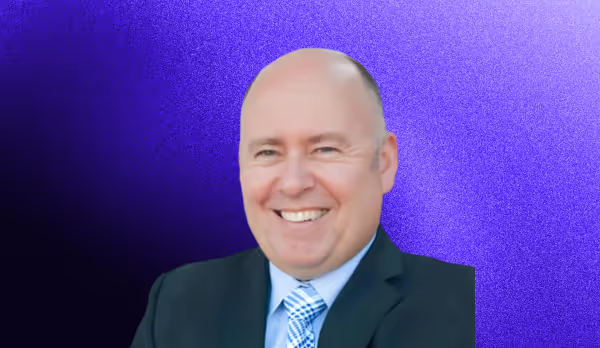
Episode 133
.avif)
In this episode we talked about:
- Why the 95/5 rule suggests your revenue problem is not just about the checkout basket.
- How AI is beginning to intercept buying journeys before they ever reach a traditional search engine.
- The technical and regulatory barriers that kept alcohol penetration in Ecommerce at only 10%.
- How to use AI data graphs to predict the exact products and labels a specific demographic will respond to.
- Why the better together proposition is essential for increasing purchase frequency.
- The psychological reasons behind why consumers make irrational, non-price-driven purchases.
- How legacy industries like alcohol are moving from traditional distribution to D2C models.
- The future of regulated products in Ecommerce beyond just alcohol.
🎧 Listen now on Apple Podcasts, Spotify, or YouTube

Episode highlights:
3:00 – What is Drinks and the complexity of regulated products
6:30 – How AI predicts what your customers actually want to buy
9:15 – Moving discovery from Google to LLM engines
15:20 – The 95/5 rule: Why conversion optimization has limits
18:40 – The expansion of THC and other regulated categories
21:10 – Psychology of the monkey chasing the banana
Andy's Bottom Line: You can tune your checkout conversion all day long, but you're just optimizing a fixed revenue pool — the real growth lever is the 95% of your customers who aren't in the market today, and you only reach them by giving them new reasons to visit (adjacent categories like alcohol with flowers, meal kits, or media) that lift basket size and purchase frequency at the same time.
Andy Lark — Transcript
The Ecommerce Toolbox: Expert Perspectives • Human-Reviewed Transcript
[00:00:00] Andy Lark: The majority of your customers are not in the market today for what you want. So, we can spend all day trying to optimize and fix our baskets, but if we don't fix the ultimate problem, which is giving consumers more reason to visit us and more reason to buy from us and breaking that into a purchase cycle, we're never going to fix our revenue problem.
[00:00:21] Kailin Noivo: Excited for today's podcast with Andy. Andy's a seasoned vet. He's been in ecom for quite a long time, and even dated himself in the podcast. He's sold things like computers online through Dell to other products. It's a really interesting episode on how to sell regulated products on the Internet, something I didn't know too much about, going into the podcast. So, I hope you all enjoy it today.
[00:00:43] Kailin Noivo: Joining us today, we have Andy Lark, who's an advisor at DRINKS. Welcome, Andy.
[00:00:47] Andy Lark: Hey. Great to be with you, Kailin. Yeah.
[00:00:50] Kailin Noivo: Awesome. Why don't you kick us off by telling us a bit about where you are in your career journey and how you ended up at DRINKS?
[00:00:56] Andy Lark: Oh, man. I'm old and tired, unlike you youngsters. So, I was sort of around at the birth of ecommerce and was up to my neck in building what became billion-dollar-plus ecommerce sites at places like Dell and Sun Microsystems and a whole range of other places. So, I was there when, you know, people were running around trying to put the 'dot' in dot com and get everything going. And since then, it's been a long journey, where you just watch it continually evolving, and you know, one half of me sort of sits here and ironically goes, I'm always torn because part of me goes, 'Oh, we kind of have failed, guys.' Like, you know, if you look at aggregate ecommerce penetration, it's actually, you know, not at 100%. You would think, like, I can't stand driving to the grocery store and Amazon's my default for just about everything, and it comes in a few hours. Why would I bother getting in the car? But on the other side of it, you just look, it's just remarkable, and we tend to forget just how incredible it is that, yeah, I want my favorite soap or I've run out of whatever I've run out of, and a few clicks later, it's hitting my way. You know, that's a pretty incredible transformation in commerce itself. But, yeah, it's been a long journey, a long and wild ride. Yes.
[00:02:13] Kailin Noivo: Very cool. For those that don't know, maybe tell us a bit about what is DRINKS?
[00:02:17] Andy Lark: Oh, yeah. Sure. So, DRINKS is a fantastic business. So DRINKS, as the name would suggest, had its origin in the wonderful world of alcoholic beverages as a D2C company, very, very successful at that, but now has moved entirely away from that. So, what we do essentially is we allow any ecommerce site to add regulated products into their cart sequence. Don't have to do anything. We handle everything: shipping, compliance, tax, all of those burdens that come with selling a regulated product, and simply put, what that means is if you've got an audience with an affinity for alcohol and alcohol is actually one of the highest affinity categories out there. So, you go to quince.com, you go to urbanstems, you're buying flowers, it would seem somewhat natural you'd add a bottle of champagne, maybe with it. You can do that with a click and dramatically shift both the purchase pattern with the consumer and then, on the other side of the fence, significantly improve your basket sizes with really high-value products.
[00:03:18] Kailin Noivo: That's really, really cool. So, like, high level, if I'm selling flowers on the Internet and I need to add, like, a regulated category like alcohol, I'm going to come to you guys. You guys are going to help me basically upsell my carts by also selling champagne with my flowers. Correct?
[00:03:33] Andy Lark: Yeah. Exactly. And, look, part of my heritage is as a marketer, right? And I think, you know, that it's a really interesting sort of observation you're making because if you think about a lot of ecommerce purchases, we think about them as being completely fluid, right? Everyone's buying online all the time. Actually, most consumers buy occasionally. They have quite high what we call inter-purchase periods. And so what you're also looking at is this idea that if I can give them more reasons to come to my site for more things, they're going to buy more products while they're there. So, you're not just increasing that basket size, you're shifting that inter-purchase period by adding an entirely new category to the site. And it's a big theme in ecommerce right now, this idea that I have to change the buying frequency cycle with my consumers. We tend to look at sites like Amazon, which sell pretty much everything imaginable on demand, and you go, "Okay. Well, that's fantastic. They've got really high frequency purchasing patterns." But for the majority of the ecommerce merchants, the purchasing frequency is quite low. It could be once every three months, once every month, or occasional purchasing. The more reasons a consumer's got to hit your site, the more they're going to buy in aggregate over time.
[00:04:49] Kailin Noivo: Very cool. Tell me a bit more. Like, obviously, AI and ecom has been a big, big topic of discussion. I noticed you guys kind of describe yourselves as an AI-led platform. Maybe talk to me a bit about that, where you guys are really leveraging AI. How is that kind of applicable in this use case out of your reality?
[00:05:06] Andy Lark: Yeah. Absolutely. So, obviously, AI enables us to build, deploy, and get everything done without the ecommerce merchant having to do anything, really, but the other side of it, for us, the focus has really been on, you mentioned, kind of, you're running a flower shop, and your target is a particular demographic. You go, "Okay. Where do I start? What wine do I sell them? What's going to appeal?" Well, using our enormous data graph, one of the largest around, we can actually tell you. We can use AI to predict not just these are the styles of wine or alcohol that a consumer that visits your site might enjoy, but we can also tell you what labels they're most likely to respond to, what style of label they're going to respond to. So, you think about someone like Quince, which is, I love their site. I love their products. They sell premium products at a really affordable price, so they do attract a premium audience, right? So, it makes sense for them to be selling Dom Pérignon and high-value wines alongside other styles of wine. Where, let's say, you're purchasing flowers, and your basket size is, let's say, $40 or $50, probably slapping a $200 bottle of wine alongside for that audience is not something that may work. But getting the right pricing, the right packaging, the right products and merchandising, that's the magic AI can work for a merchant. Yeah. And, look, obviously, it helps you intercept other parts of buying journeys as well. I mean, the shift to AI, but a base search, for instance, for those of us that are reasonably native to AI. I mean, I haven't searched on Google for, I don't know how long, I start the majority of my just general searches inside of Perplexity, and occasionally, I'll try not to do it in ChatGPT so I don't pollute everything else I'm doing there, but suddenly now I'm intercepting whole new search criteria across AI.
[00:07:01] Kailin Noivo: That's interesting. I think you're right. I think everyone's looking at AI, at least from my perspective, in two lenses, like operational efficiencies inside your business, agentic development, all things like that, and then the things I'm more so interested is understanding how they intersect into commerce, right? So, you're right. Discoverability is happening in LLM engines. Makes sense that traffic's growing. It's converting higher, allegedly. So, that's really interesting. Like, what was the fundamental problem that you guys were solving for your merchants? Was it that, hey, you have different alcohol regulations in different countries and likely even amongst different states? And then you guys are really just bringing them the technology that enables them to just click a button and do everything, from collecting taxes?
[00:07:46] Andy Lark: To solve this, it's a great question. To solve this problem, we had to do a number of things, and these are very complicated things to sell. First of all, the alcohol industry, as an example, is tied up in a prohibition-era distribution funnel. It's rife with regulation and taxation complexity, both at a state and even an accounting level. So, that's the first problem to solve. We've solved that completely and automated it, both for wineries and for ecommerce brands. So, if you're a winery and you're looking to sell online, we make that simple and easy for the first time. The second problem you have to solve is, okay, that sounds good. What do I sell? I mean, should I sell Rosé? Should I sell Champagne? Should I sell Cabernets? What should I sell? Should I sell nonalcoholic wines? And the simple answer is that AI can help solve that problem along with our expertise. And then the third problem I have to solve is that all sounds good, I know what I want to sell, but how do I get it? And I don't want to buy wine and warehouse it, and I don't want to ship it, and I don't want to manage all of that. Well, we solved that as well. So, if you look at that and a whole lot of other magic, you can sit with a ecommerce merchant and go, "If you want to flick on alcohol on your site, that's a very simple and easy process for us to do."
[00:09:00] Kailin Noivo: So, actually, now you have a different part of my brain going. So, you have alcohol, and then you have flowers, right? That's a very clear, like, synergy. Is there any other synergies for alcohol that you guys are maybe surprised by?
[00:09:15] Andy Lark: Nearly every industry. You look at Quince, who's in fashion. You look at Forbes, who's in media. You look at grocery. The list is just endless. I mean, and when we think about grocery, we think about the big mega category of grocery. We don't tend to think about the hundreds of thousands of folks that subscribe to meal kits, or they subscribe to, let's say, their favorite venison or steak delivery service. And then you think about influencers, right? We've done some great work with Half Baked Harvest, really powerful influencer sites surfacing great recommendations on foods, on menus, and things like that. So, the list is just endless. We're just scratching the surface right now on where this fits and where it sits, and nearly any category goes well together. Now, I'm not sure you'd snag a bottle of champagne to go with a new computer, but you know, you get the drift. I think it's more in the true consumer side product vector. Media, for instance, is another very strong category for us.
[00:10:21] Midroll: If you're listening to The Ecommerce Toolbox, you're entitled to a podcast exclusive website audit. Go to noibu.com/podcast-audit for a free scan that uncovers the hidden friction blocking your conversions and shows you where you're leaking revenue.
[00:10:35] Kailin Noivo: Really, really, really interesting. How did you solve, like, the how did you guys solve the problem of, like, okay, Valentine's Day is coming up? It's a two-part question. Number one, I want to order my wife flowers. Makes sense. I'm going to attach a bottle of champagne. How did you guys solve the problem of, like, sending alcohol to another person? Like, do I need to, like, upload her driver's license? Obviously, I'm 21, like...
[00:11:00] Andy Lark: Yeah. We handle the compliance verification and age verification as part of our process. We handle the delivery. We handle the delivery expertise to go, "I need to see a driver's license. This is alcohol." So, we handle all of that automatically; that's built into the platform. And those are sort of, that's a good question, because those are sort of the barriers you immediately run into when you chat to people. I think one of the other really interesting things, and this applies to all ecommerce categories, right? And it goes back to that original point I made. As someone who's old and tired in the ecommerce space, I often look at it and go, "Man, ecommerce has been incredible. What a success story. What an industry." And I go, "Yeah, but alcohol penetration in ecommerce is like 10% of total volume." It's so underpenetrated. And even the leading categories are at 20% penetration. Consumers as a whole are heavily oriented towards ecommerce for convenience or access to selection. And this is a key point because suddenly, if I've got products on my side, you could get flowers from anywhere, right? Yeah. On the way home, you could pull in somewhere and snag some flowers. You can get flowers from anywhere, but you can't get flowers from anywhere with a beautiful bottle of Rosé that's got a big gold star on it and isn't available anywhere else. So, what you're trying to do with these kinds of products is build a sense of differentiation, build a sense of exclusivity, build a sense of a better together proposition for the customer that causes them to go, "Wow, this is super cool. I can't get this anywhere else. I'm going to come back here for this gifting, or whatever I'm trying to achieve." So, it's the age-old problem in ecommerce is how do I get the consumer to shift their buying pattern.
[00:12:48] Kailin Noivo: That's really cool. Yeah. I know ordering alcohol wasn't exactly, like, easy. It was probably a technical barrier from the beginning.
[00:12:55] Andy Lark: Oh my God. It's easier to buy a Tesla online.
[00:12:58] Kailin Noivo: Yeah. Yep.
[00:13:02] Andy Lark: So, yeah. And so we set out to solve that problem. We wanted it to be easier than buying a Tesla. We wanted it to be, click, you've got wine on the way.
[00:13:11] Kailin Noivo: I love that. No, really cool. Shifting, I know that you spent a lot of your career on, like, marketing and conversion rate optimization. How are you thinking about that in terms of, like, the merchants using your software? You're obviously injecting some additional steps into the checkout process. Like, how should they think about increasing overall revenue, where it's like you're adding steps? Maybe that decreases conversion a little bit.
[00:13:36] Andy Lark: Yeah. And, look, the trick is not to add steps. The trick is I'm shopping on the page. I see shopping on the page. I see a better, together UrbanStems, for instance, is very good at this, where you've got the wine and the flowers together. I just want that click, click, click. It's almost zero impact on the basket conversion process, right? Now, as someone who's been around ecommerce forever, I don't want to dismiss the importance of focusing on your conversion speed and how frictionless you can make that, and you know, you're probably like me. You can tell how many boring meetings you've been in a week by the number of Amazon packages landing on your doorstep. That is a direct correlation between the two. You're like, and then you're wondering, why did I order all those sponges online? Like, now I've got 200. And so, yeah, ecommerce leaders are right to focus on conversion. We've made that painless. That's not the fundamental issue, though. There's a really core rule that originated out of fundamentally out of B2B marketing, but it's equally applicable in the extreme to consumer goods marketing online, and it's called the 95-5 rule. And what, that sort, it's not really a rule technically. It's more of a rubric or a construct, but it's true. And that is the majority of your customers are not in the market today for what you want. So, we can spend all day trying to optimize and fix our baskets, but if we don't fix the ultimate problem, which is giving consumers more reason to visit us and more reason to buy from us and breaking that into the purchase cycle, we're never going to fix our revenue problem. We are basically optimizing a fixed revenue pool that we have today and paying a lot of money to try and increase that revenue pool, but we're not really fixing the majority of the problem, which is that the majority of customers are not buying from us at all today. And how do I increase their purchase frequency? How do I increase their visit recency to my site? And then when they're there, how do I get my basket up in size dramatically? And if I fix that problem, I could tune my conversion rate at the point of basket origination by 1%, 2%, 5%. I can convert that. I can improve that all day long, but I'm not actually going to solve my fundamental scaling and growth problem as an ecommerce business.
[00:15:56] Kailin Noivo: Makes sense. Have you guys ever considered the synergy of other regulated products, or are you just looking at it?
[00:16:02] Andy Lark: Absolutely. We're looking closely at it. You look at the expansion of THC beverages, for instance, in key sectors of the market. That's a really interesting dynamic, so we're working on that at the moment. You look at the overall cannabis market. That is a core trend within specific demographics, and then you look at all the pharmacological products that sit out there that people want. So, there's a 100 dimensions to regulated products. The one, you know, so we're looking at all of that. We're looking at implementing all of that. We've got a lot of demand and interest from merchants for that. But on the other side of the spectrum, alcohol's a 250-300-billion-dollar ecommerce category in the U.S. So, a 10% ecommerce penetration there is heaps of room to grow there, and because it is so underpenetrated, that's the opportunity for the merchant. We do buy alcohol. We buy a lot of alcohol, but we are locked up in very traditional purchasing patterns. And by exposing alcohol in more places to more people, we grow the category as a whole as well.
[00:17:05] Kailin Noivo: How are you guys seeing with alcohol consumption as a whole? Like, I read an article not that long ago that, like, overall sales are actually pretty flat for the category.
[00:17:16] Andy Lark: Yeah. Look. Alcohol sales have always historically gone up and down. It's a squiggly line. In fact, the squiggly line exists in most categories. And whenever you've got economic pressure, consumer wallets under pressure, discretionary items such as that bottle of wine or whatever it might be, they come under pressure. So, a lot of this has to do with economic cycles. There's obviously a richness of choices around what you imbue to celebrate these days, and so that's a pressure point. So, there's a lot of pressure points, but, look, at the end of the day, we're talking about an enormous, you know, 250, 300-billion-dollar market, and it goes up and down cyclically, and it's a great market and industry to be in.
[00:18:03] Kailin Noivo: No. It makes sense. As we're looking to wrap up soon, Andy, talk to me a bit about, maybe since you joined as an advisor, has there been a business that you could talk about that has kind of joined the platform that you're a bit not necessarily surprised, but you're like, "Okay. This is cool. This is not something that, like, is not a category or a type of business that out of the gate I would have expected, but it makes a lot of sense."
[00:18:24] Andy Lark: Yeah. Look, if you look at someone like Quince, right? Quince is a remarkable ecommerce brand, just remarkable, not just in terms of the quality of goods they have and the price points they have, but the fact that they have built a true industrial-grade ecommerce platform. And when you look at it, and you go, you look at the variety and what's on the Quince site, and you go, "Okay. Would alcohol fit here?" But they are some of the smartest ecommerce folks I've run into in a long time around the idea of starting with the customer and understanding what the customer's moment of doubt, desire, or dissatisfaction is, something I call the mods, right? And that idea that if I'm on Quince and I'm searching for that new cashmere hoodie and I'm encountering premium bag products, I'm in an entire shopping experience that is around highly available luxury products that I can afford and enjoy, and then I suddenly discover champagne and wine and caviar and all kinds of things. That ability to extend the buying journey and engage consumers is just phenomenal. They are very, very good.
[00:19:39] Kailin Noivo: That's really cool, actually. And that reminds me. Have you been to Canada before?
[00:19:43] Andy Lark: I've been there many, many, many times, and all seasons as well.
[00:19:48] Kailin Noivo: Cool. So, there's a local, well, it's only in Canada. It's called Holt Renfrew. It's like a luxury kind of department store. They're actually customer.
[00:19:56] Andy Lark: Yeah. Yeah. I know it well. Yeah.
[00:19:57] Kailin Noivo: And it's kind of similar to what you're saying.
[00:20:00] Andy Lark: Yeah. And that's right. And the great multiproduct brands understand their number one job is to craft experiences while you're there that surprise and delight you and cause you to open your aperture about the brand. And they're very, very good. Quince and others are very, very good at this.
[00:20:17] Kailin Noivo: Yeah. It kind of reminds me of, like, what they do in store, but you, like, you guys are just kind of helping it online. Like, you're there, you see a luxury pair of shoes, and then there's, like, a high-end croissant.
[00:20:27] Andy Lark: What they're tapping into is another, you know, I'm putting my sort of professor or marketing hat on here when I go out and teach people about marketing, and I say, "Look, you know, one of the single biggest myths about ecommerce as a whole is that we are rational decision makers." You know? You're looking for that new pair of designer jeans, perhaps, and so you hit the website, and I'm doing research, and I'm going to go into a funnel, and I'm going to, you know, and I'm going to think, and then I'm going to price compare. Not so much. You're sitting in a meeting. You're bored shitless. "Oh, shit. Yeah. I got to grab some new jeans." Before you know it, on the whole site, "Oh, croissants." Click. "I have some of them too." You know what I mean? The rational decision-making is an illusion. We are one DNA string off monkeys, right, and we chase the banana. So, you know, and people say to me, "I don't think that's true, Andy, and I think we, you know, consumers are very price shoppers," and I'm like, "Really? Let me just pop over to your house and have a look in your closet. Maybe you could explain to me some of these purchases." You know? And they're like, "No. I don't want you to do that. That's creepy. I don't want you to do that, but you're right. I guess you're right." And so, yeah. And you just have to look at your experience in heading home from the grocery store where you set out to buy bread, butter, and some milk, and you come home with, you know, a rare chocolate drink mix, four bottles of Spritz, some new energy drinks, some electrolyte product in sachets that just cost you $60. And you get home, and they're like, "Honey, what is all this other stuff you got?" You know? "Well, I just..." you know? So, yeah, it's fascinating, right, how the brain works when we get online and we start shopping.
[00:22:05] Kailin Noivo: Yeah. No. It's really, really cool. Well, Andy, thanks for taking the time. I know it's early morning for you, so I really appreciate you hopping on.
[00:22:12] Andy Lark: My pleasure, man.
[00:22:13] Kailin Noivo: This is a great ep.
[00:22:13] Andy Lark: Keep up the good work. Keep teaching everyone about ecommerce. There's lots to learn.
[00:22:19] Kailin Noivo: One day at a time. Thanks, Andy.
[00:22:22] Andy Lark: Yeah. Take care, man. See you.
[00:22:25] Outro: The Ecommerce Toolbox Expert Perspectives is brought to you by Noibu. To find out more about Noibu and how we can help you debug your ecommerce site and rocket your revenue, visit www.noibu.com. That's n-o-i-b-u.com. And then make sure to search for The Ecommerce Toolbox Expert Perspectives on Apple Podcasts, Spotify, or anywhere else podcasts are found, and click subscribe so you don't miss out on any future episodes. On behalf of the team here at Noibu, thanks for listening.
FAQ
Other episodes


.png)
.png)
.png)
.png)

.png)
.png)
.png)
.avif)
.avif)
.avif)
.avif)
.avif)

.avif)
.avif)
.avif)
.avif)
.avif)
.avif)

.avif)
.avif)
.avif)
.png)
.avif)
.avif)
.avif)

.avif)
.avif)
.avif)
.avif)
.avif)
.avif)
.avif)
.avif)
.avif)
.avif)
.avif)
.avif)
.avif)
.avif)
.avif)
.avif)
.avif)
.avif)
.avif)
.avif)
.avif)
.avif)
.avif)
.avif)
.avif)
.avif)
.avif)
.avif)
.avif)
.avif)
.avif)
.avif)
.avif)
.avif)
.avif)
.avif)
.avif)

.avif)
.avif)
.avif)
.avif)
.avif)
.avif)
.avif)
.avif)
.avif)
.avif)
.avif)
.avif)
.avif)
.avif)
.avif)
.avif)
.avif)
.avif)
.avif)
.avif)
.avif)
.avif)
.avif)
.avif)

Audit your site today
Understand the revenue impact of all errors on your site and how to swiftly reproduce and resolve.