
Expert Perspectives
Expert Perspectives
Episode 113

.avif)
In this episode we talked about:
- How AI and algorithmic tools actually increase the need for creative volume, merchandising collaboration, and skilled human oversight
- Why the boundary between brand and performance marketing has collapsed and what that means for team structure and talent expectations
- Why adaptability and hybrid skill sets (creative + analytical) now matter more than deep specialization in any one channel or platform
- How rising CACs and social behavior shifts are pushing brands toward influencer ecosystems and storytelling-led acquisition
- Why AI won’t replace marketers, but will demand new competencies, from prompt literacy to creative tooling like Canva
- The operational and strategic differences between marketing seasonal/holiday-driven brands vs. full-home lifestyle brands
- How to align teams for faster experimentation and multichannel orchestration in a constantly changing environment
🎧 Listen now on Apple Podcasts, Spotify, or YouTube

Episode highlights:
02:25 – Balancing brand building and direct response
03:48 – Marketing differences between Ballard Designs and Grandin Road
05:28 – Martech growth, tool overlap and vendor evolution
07:22 – The reality Of AI: More human input, not less
15:24 – Rising CACs, storytelling, and the power Of influencers
18:24 – Closing thoughts: Will AI search engines drive traffic?
Stephen's bottom line: AI won’t replace marketers, it raises the bar for them. Modern ecommerce teams must adapt quickly, blend creative and analytical skills, master evolving martech, and lean into high-volume social storytelling to stay competitive.
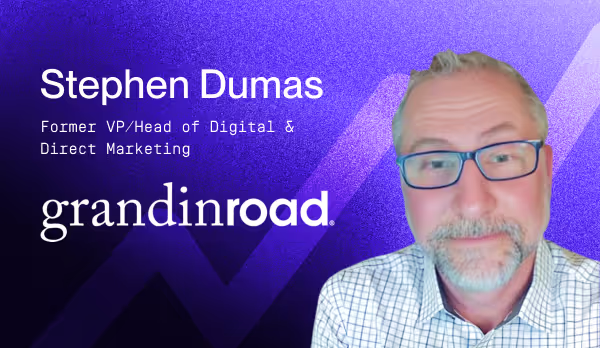
Stephen (Steve) Dumas — Transcript
Ecommerce Toolbox: Expert Perspectives • Human-Reviewed Transcript
[00:00:00] Stephen Dumas: I think marketing's become a lot more storytelling, you know, content. We said fifteen years ago that content was king, but the way content was presented fifteen years ago, it's very blog; the landing pages had a lot more content on them, you know, you did a lot more driving people to these content-heavy areas of your site, whereas now it's social.
[00:00:26] Kailin Noivo: Super excited for you folks to hear our podcast with Steve today. We touched on a whole bunch of things, from broad ecom leadership to picking up very old stacks and having to redo them to good old-fashioned CAC to LTV. How do you find the most profitable channels, double down in scale? Excited to have you folks listen to this today.
[00:00:46] Kailin Noivo: Welcome to another episode of the Ecommerce Toolbox Expert's Perspective. Joining us today, we got Steve Dumas, all the way from Atlanta. He's joining us, so we're super excited to have you on the show today, Steve.
[00:00:58] Stephen Dumas: Thank you. Happy to be here.
[00:01:00] Kailin Noivo: Awesome. Why don't you start off by telling us a bit about your career journey? You've been with different companies, including IBM, and been in the ecom space. So maybe talk to us a bit about your career journey and how you ended up in your previous role.
[00:01:13] Stephen Dumas: Well, I've been in the digital space really since 2004. Ended up working at Cornerstone Brands, really, is where I, you know, went from email marketing, which is where I started, to all of the channels, paid search, comparison, shopping engines, etc., ecommerce, really doing a lot there. Left there briefly, went to IBM, went to Silverpop, actually, which was purchased by IBM and did that for 4+ years, working with their sales team on retail segmentation and storytelling and then went back to Ballard in 2017, where I really built out their digital framework foundation a little bit more fully. They are really a legacy catalog company, and they wanted to move to digital first, and so I helped them do that. And then I was promoted from Ballard Designs to Grandin Road at the beginning of 2024 to do the same thing. So Ballard and Grandin are both part of the same parent company. So, I've been in the ecommerce space in total, you know, 13 or 14 years, I think.
[00:02:38] Kailin Noivo: Very cool. Yeah. Let's maybe start off with what a lot of folks are thinking. Talk to us a bit about your journey and how you thought about balancing brand building versus driving kind of direct response marketing. And, yeah, how does that change depending on the type of business that you're doing marketing for?
[00:02:58] Stephen Dumas: Well, it's changed quite a bit from 13 years ago to now. And I think there's so much overlap with brand and customer acquisition and storytelling and growth. I think it's all really combined now, whereas it used to be very siloed, and you would have brand over here and they had a certain particular set of goals, really with digital. A lot of those lines have been blurred, and what used to be single-channel marketing programs have really, now the platforms can do a full funnel; so it's changed considerably, really, from, you know, 10, 15 years ago, really rapidly as well.
[00:03:48] Kailin Noivo: Very cool. Was there, really, I know that you mentioned they're part of the same kind of parent company, but were there any kind of differences in marketing strategies between Ballard Designs and Grandin Road? Like, were they kind of similar retailers in history? I'm from Canada, so I'm not super familiar with them. So sorry if there's an obvious answer, but yeah, curious if they had, if they needed kind of distinct strategies or were they both kinda similar from a digital maturity slash brand positioning standpoint?
[00:04:14] Stephen Dumas: Their brand recognition was a little bit different. Grandin Road also sold a product that was very item-specific and more seasonal than Ballard, which sold whole home, what they call whole home very specifically; so furniture, heavy in furniture, heavy in home decor, whereas Grandin Road was a lot more seasonal decor focused more on holiday, some outdoor, and they were just expanding their product line, really when I started there at the 2024, but as far as marketing strategy goes, I think their customer bases were a little different. So it does require, to understand, you know, you have to really understand who your customers are, what they're looking for, where they're on the buyer cycle. The brand vibe was different, and so, how we spoke to the customer at Ballard was very different from how we spoke to them at Grandin.
[00:05:15] Kailin Noivo: During that whole kind of 15- to 20-year journey, you'd mentioned that some businesses you worked for were maybe a bit behind the curve on digital adoption. Have you ever been in a scenario where there's been almost, like, more of a bloated enterprise stack where you've had to actually slim it down? And have you been on the other side of the coin, or has it always been a bit more on the side of the coin where you're lacking tooling versus having too much?
[00:05:41] Stephen Dumas: Yeah. No. If anything, we lacked tools. It was always on the building side, bringing on new marketing tech, but you know, I think the marketing tech process, you bring on something you said for a couple of years, they may not keep up with the marketplace, or they may be acquired. It may change the user interface. It may change how effective it was, so I mean, it's a little bit fluid, but definitely Cornerstone was on the growth end of marketing technology, not really reducing. But I have to say that over time, I think again, as those solutions get acquired, it's very possible that there are overlapping functions between two marketing solutions. One that didn't start in, you know, in one way, but ends up, you know, ended up evolving their tool and another, and then you end up with a couple of platforms where there is some overlap in terms of function and value. So, I mean, that has happened a couple of times, but not as often as the acquisition of new vendors, I think.
[00:07:00] Midroll: If you're listening to the Ecommerce Toolbox, you're entitled to a podcast exclusive website audit. Go to noibu.com/podcast-audit for a free scan that uncovers the hidden friction blocking your conversions and shows you where you're leaking revenue.
[00:07:15] Kailin Noivo: Makes sense. And we've been hearing a lot in some of the episodes that I've been filming that maybe people's boards and leadership teams and their expectations around AI driving efficiency and maybe needing less tools or less humans to kind of run the operation, maybe talk to us a bit about where you think that's at. Do you think that's overhyped, sounds good in the boardroom but doesn't play out in the field, or what kind of side of the fence are you there?
[00:07:41] Stephen Dumas: AI, I mean, 15 years ago, was personalization, and then it became algorithms. And so I think there's been a level of automation that's been happening in the marketplace for some time. So a lot of these tools, and very recently, have started calling their products sort of AI-light or AI-driven, and you know, my experience has been that they require more human attention and not less. If, for instance, we brought on a solution that was email-focused, and you know, it was very algorithmically driven, but it altered the way we did email entirely, where it used to be more siloed with partnership with creative. Creatives, actually, their workload for the email actually went up. So because every email that was being served had the potential to target specific individuals versus broad groups of people, it actually required more creative; so you had to do a lot more preparation, planning, and then merchandising also was much more involved, where they had sort of been a little bit more passive in the past, they actually were much more involved. So I think, and it did require the team itself to change its skill set. So where they may not have done, they may not have had as much feedback, let's say, in email copy or subject lines, they had a lot more with the new tool because of just the amount of volume required to actually run the algorithm and the tool. So there needed to be enough assets essentially to feed this engine. So, to my point, I think it uses more. I think AI uses more. It requires more humans. If you're a say paid search expert, that experience using Google, for instance, is gonna be very different from using Meta. It's not the same AI, it's not the same; they're not driven by the same engines, and how you use them is very different. They may not have the same skill set. So I'm not really bought into that AI is going to replace everyone, I think it has potential to help with certain functions. Absolutely. Either you can do a lot more content and creative writing, I think, faster and a lot more volume, with fewer people, but you still need those people to understand what they're asking of AI, you know, there has to be that understanding of the language so that the output makes sense, and then you can edit it and fine-tune it for your brand. Does that make sense?
[00:10:51] Kailin Noivo: Yeah. It does, and it's interesting. A follow-up that I had on that thread, though, is, do you think it's the same skills or different skills? Because it sounds like it potentially removes some work, but then adds more and net net, it's probably a bit more of an adding than a taking, but do you think it's like the linear, do you think it's different skills, I guess, yes, is the question, or is it the same kind of types of skills to operate?
[00:11:16] Stephen Dumas: I mean, no. The skills definitely evolved. I mean, if you're bringing on a tool, then you have a particular platform, and the platform is very sophisticated, more sophisticated than what you were used to using or what your team was used to using; they have to adapt to the new tool, and that may require new skills. Absolutely.
[00:11:36] Kailin Noivo: As a quick follow-up on that, you've built kind of some teams across different areas before, merchandising, ops, ecom, marketing. Do you think that AI is gonna impact all those different types of skill sets or roles equally, or do you think there are certain roles that are potentially gonna be impacted more than others?
[00:11:56] Stephen Dumas: I'm not sure. I don't think everything is going to be impacted the same, but I don't know, it's really hard to say how specifically merchandising would change versus, you know, creative versus, you know, the marketing managers. I think digital in and of itself is changing so frequently that one of the skills that I would mentor my teams about is always being adaptable, learning something new, and going deeper within the marketing tech. There was a time when you could be sort of a creative marketer, and that was okay, that would drive, that would take you through, you know, sort of your career, or a time where you were more of a marketing and data driven, you know, it really they just like with what I was how I started the conversation about brand and, brand marketing and brand awareness and upper funnel, sort of all blending together. I think digital marketers have to have that sort of right-brain, left-brain capability, and they need to develop those skills because I think if you're using Meta, for instance, it's very creatively driven. You have to understand how the creative is actually gonna drive your business, even if you're not designing it. You have to understand how to communicate to the creative team why something works or doesn't work, you know, and I think so, there's a lot of that blending and overlap, but still requires different people to do it; so the skill set to develop creative is going to be different. I don't know how that's gonna be impacted by AI. I think there probably are tools that will make creative editing easier, like Canva, for instance. You know, I think the marketing team should understand how Canva works because the amount of creative required to run organic social or paid social, you know, there may not be the creative resources to do it. So marketing needs to understand how they can edit the visuals on the fly, understand what those tools do, and I think Canva's a perfect example of how you need to understand the creative side in order to support the creative team, who may not have the bandwidth to do absolutely every piece of creative you need for that program.
[00:14:36] Kailin Noivo: Do you think that the rising CACs in just, like, advertising overall, since, like, on the back of COVID, do you think the ideal channel marketing mix for most businesses has kinda changed on the back of that? Like, how do you think about retention marketing versus acquisition marketing? And, yeah, maybe talk to us a bit about that.
[00:14:58] Stephen Dumas: Well, I think marketing has become a lot more storytelling, you know, content. We said fifteen years ago that content was king, but the way content was presented fifteen years ago, it’s very blog; the landing pages had a lot more content on them, you know, you did a lot more driving people to these content-heavy areas of your site, whereas now it's social, social content. And so leaning into social content, which, you know, again has to be high volume. I think that's changed a lot. Influencers are a very important part of the ecosystem in the last couple of years, but they weren't ten years ago, or they weren't fifteen years ago. There are a lot more experts in your product today because you are leaning on the user, because social media sort of allows you to access those people. And, obviously, there are professional influencers. There are people actually that's how they're making a living. So I think they're good if you do it correctly, if you vet them, if you are looking for people that are authentically interested in your brand, I think they're, you know, definitely tremendous advocates for your brand. But I think that's really what has changed the most over the years. Now I do think the platforms themselves, like Google and Meta, their platforms are constantly changing to improve targeting and audience identification, and again, full funnel. So, you know, you have to understand that your dollars are probably going, you have to understand how your dollars are going full funnel and where they're going, whereas I think for an influencer program, for instance, you have a lot more, their marketing is still more heavily involved in the orchestration and the story, and you know, the output of an influencer program.
[00:17:08] Kailin Noivo: Yeah. No. Absolutely. And, Steve, as we look to round off the conversation today, there's been a lot of buzz and a lot of hype about the percentage of traffic that's coming in through the new referral engine, ChatGPT, Claude, the different, like basically, AI systems. From your perspective, is that all hype? Were you actually seeing that in the data? Like, were you and, maybe, talk to us a bit about that. I guess the question is, were you seeing a good amount of traffic flow through these new engines, or was that kind of still super nascent?
[00:17:46] Stephen Dumas: I can see how it could happen for sure. I mean, I think it's just like how social has changed search, for instance, you know, people searching using TikTok and Instagram, etc, over using traditional search engines to get information. I think if there are sources within ChatGPT, for instance, in their responses, I think people absolutely will click on those sources and go to those web pages. So, I absolutely can see where that would begin to take a piece of that traffic for sure. I just have not seen a lot of it so far.
[00:18:33] Kailin Noivo: It's funny you say that everyone has a very similar answer. Like, no one's seen it in their data yet. Everyone thinks it's coming, and then yeah, we'll see. We'll see. Cool. Well, Steve, I want to thank you for your time. This is a great episode. If someone wants to connect with you, how can they find you?
[00:18:48] Stephen Dumas: Well, I'm on LinkedIn for sure. It’s Stephen (Steve) Dumas on LinkedIn, so yeah, happy to follow you or reach out via message. I'm happy to respond.
[00:19:03] Kailin Noivo: Awesome. Thanks again for your time, Steve.
[00:19:04] Stephen Dumas: Alright. Thank you, Kailin. Bye.
[00:19:07] Outro: The Ecommerce Toolbox Expert’s Perspectives is brought to you by Noibu. To find out more about Noibu and how we can help you debug your ecommerce site and rocket your revenue, visit www.noibu.com. That's n-o-i-b-u.com. And then make sure to search for The Ecommerce Toolbox Expert’s Perspectives on Apple Podcasts, Spotify, or anywhere else podcasts are found, and click subscribe so you don't miss out on any future episodes. On behalf of the team here at Noibu, thanks for listening.
FAQ
Other episodes


.png)
.png)
.png)
.png)
.png)

.png)
.png)
.png)
.avif)
.avif)
.avif)
.avif)
.avif)

.avif)
.avif)
.avif)
.avif)
.avif)
.avif)

.avif)
.avif)
.avif)
.png)
.avif)
.avif)
.avif)
.avif)
.avif)
.avif)
.avif)
.avif)
.avif)
.avif)
.avif)
.avif)
.avif)
.avif)
.avif)
.avif)
.avif)
.avif)
.avif)
.avif)
.avif)
.avif)
.avif)
.avif)
.avif)
.avif)
.avif)
.avif)
.avif)
.avif)
.avif)
.avif)
.avif)
.avif)
.avif)
.avif)
.avif)
.avif)
.avif)
.avif)

.avif)
.avif)
.avif)
.avif)
.avif)
.avif)
.avif)
.avif)
.avif)
.avif)
.avif)
.avif)
.avif)
.avif)
.avif)
.avif)
.avif)
.avif)
.avif)
.avif)
.avif)
.avif)
.avif)
.avif)
Audit your site today
Understand the revenue impact of all errors on your site and how to swiftly reproduce and resolve.