Know before your customer do: How teams use Noibu Alerts to catch errors in real time

The most expensive ecommerce errors aren't the ones that take weeks to fix. They're the ones that take days to find.
A broken payment gateway. A checkout flow that stops working on a specific browser. A third-party integration silently failing on Black Friday. By the time any of these surfaces through customer complaints, the damage is already done — revenue lost, trust eroded, and a team scrambling to reconstruct what happened and when.
The teams that close that gap — from error occurring to error known — don't rely on customers to tell them something is wrong. They've set up Noibu Alerts to tell them first.
The cost of finding out late
In ecommerce, the window between an error occurring and a team becoming aware of it is where revenue disappears. Customers who hit a broken experience don't file detailed bug reports — they leave. They complete their purchase somewhere else. And they often don't come back.
Yoav Shargil, CDO of David's Bridal, describes what error detection looked like before Noibu with unusual clarity:
"Before Noibu, we were shining a flashlight, hoping to spot issues in the dark. Noibu turned the lights on. We can see the entire room, not just the corners we happened to point at. That's the difference."
— Yoav Shargil, CDO, David's Bridal
The flashlight problem isn't a resourcing problem. It's a structural one. Manual monitoring, QA cycles, and customer feedback loops are all retrospective by nature — they surface issues after impact has already accumulated. Real-time alerting changes the model entirely.
What real-time looks like in practice
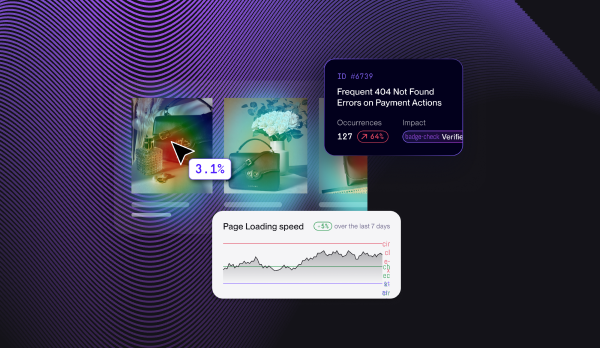
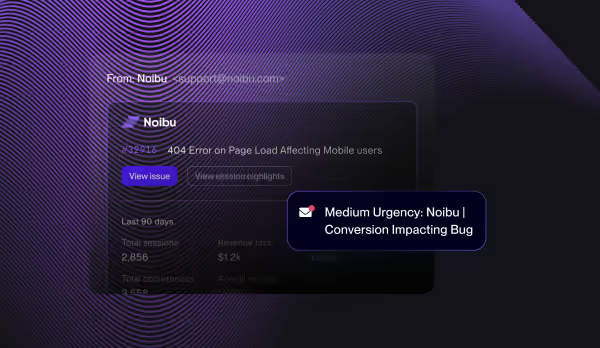
Noibu Alerts monitors every front-end session continuously and fires notifications the moment a new error emerges, an existing error spikes in volume, or a revenue impact threshold is crossed. Teams configure alerts to route to Slack, email, or any messaging tool in their stack — so the right person knows about the right problem the moment it starts.
The result is a fundamentally different relationship with site health. Rather than discovering issues in the rearview mirror, teams see them as they happen — with the revenue context and technical detail already attached.
Yannick Vial, Senior Vice President of Digital Development & Unified Commerce at La Maisons Simons, captures what that shift means operationally:
"We chose Noibu because it's proactive — it tells us when there's a problem. If a field isn't available or has an issue, we get that information back immediately and can fix it on the spot. It's live, it's done."
— Yannick Vial, SVP Digital Development & Unified Commerce, La Maisons Simons
"It's live, it's done" is a meaningful standard. It describes a team that resolves issues on the same day they occur — not the same week.
"It was a major problem that we wouldn't have caught ourselves"
For David's Bridal, the stakes of detection speed are particularly high. Shopping for a wedding dress carries emotional weight that most retail categories don't — an error at the wrong moment doesn't just cost a transaction, it damages trust at a moment that matters enormously to the customer.
Yoav Shargil doesn't need hypotheticals to explain what Noibu Alerts means for his team. He has a specific example:
"With the international cart issue, it was a major problem that we wouldn't have caught ourselves, but Noibu flagged it the same day it happened and we got an alert immediately."
— Yoav Shargil, CDO, David's Bridal
An international cart failure caught and resolved the same day it occurred. Without alerting, that issue could have run for days or weeks — affecting every international customer attempting to purchase during that window.
The impact of Noibu Alerts extends beyond individual incidents. For Shargil, real-time detection changes how confidently his team can ship:
"I have a long list of site enhancements I want to implement over time. Noibu gives me the confidence to release faster because I know if something breaks, I'll be alerted — and I'll know exactly how to fix it."
— Yoav Shargil, CDO, David's Bridal
This is the compounding value of real-time alerting: it doesn't just protect against errors that exist today. It makes the whole development and release process faster, because the safety net is always in place.
Designating a QA engineer to monitor alerts
At Ariat, a premium equestrian and western footwear brand, the engineering team's approach to Noibu Alerts reflects how seriously they take site health. Todd Purcell, Senior Director of Ecommerce Engineering, describes what they built:
"Noibu significantly enhanced our ability to detect and learn about previously unknown opportunities. We set up notifications via messaging tools whenever a site issue arose, and even designated a QA engineer to monitor alerts from the platform."
— Todd Purcell, Senior Director of Ecommerce Engineering, Ariat
A dedicated QA engineer monitoring Noibu Alerts is a meaningful operational commitment. It reflects the value the team places on early detection — and the recognition that staying ahead of issues is a full-time job worth resourcing properly.
For Purcell, the value of alerting connects directly to the revenue prioritization framework Ariat has built around Noibu:
"The alignment of errors with profit has been a game-changer for me. Noibu's ability to quantify the financial impact of errors is unparalleled. Knowing which errors result in revenue loss and whether they warrant inclusion in a release or hotfix has been exceptionally valuable."
— Todd Purcell, Senior Director of Ecommerce Engineering, Ariat
When alerts fire with revenue impact already attached, the decision about how to respond — hotfix now, or include in the next release — becomes a data-driven call rather than a judgment call.
Regression detection as a release standard
For Hanna Andersson, a children's and family apparel brand, Noibu Alerts has become part of the standard release workflow. Every code deployment is immediately followed by monitoring — and regressions surface within minutes if they occur.
Matt Ezyk, Senior Director of Engineering Ecommerce, describes the unlock:
"The biggest unlock for my dev team is to be able to detect regressions before they become an issue. When we release code, we know instantly if we've introduced a regression to the site, which is really powerful for us to detect the health of our business."
— Matt Ezyk, Senior Director of Engineering Ecommerce, Hanna Andersson
"Instantly" is the operative word. The alternative — discovering a regression through a spike in customer complaints or a drop in conversion data — might take hours or days. By then, the issue has already affected a significant portion of the session volume for that period.
Matt Ezyk frames the broader opportunity clearly: "We already use Noibu to detect errors, but I'm really excited to see innovation where we can really expand this revenue growth journey not just by finding errors, but now we can look at performance, we can look at the customer journey, and have a really holistic view of what's happening."
For Hanna Andersson, alerts aren't just a reactive safety net — they're the foundation of a proactive ecommerce health monitoring practice.
The errors no one else would catch
Some of the most damaging ecommerce errors aren't caused by your code at all. Third-party integrations — payment processors, marketing tags, shipping apps — can silently fail, and without monitoring every session, there's often no way to know until customers complain.
Joe Bona, Senior Software Engineer at Barstool Sports, describes how this plays out across their five Shopify storefronts — especially during high-traffic moments:
"Sometimes, there's third-party applications that have outages and we would have no other way to know that an app is out without Noibu. We've seen it at times, for example on Black Friday or Cyber Monday. Outside of just staring at the console and visiting pages, we would never know that."
— Joe Bona, Senior Software Engineer, Barstool Sports
Black Friday third-party outages caught in real time instead of discovered through post-peak revenue analysis. That's the difference between a manageable incident and a costly one.
The same capability applies year-round. Noibu Alerts surfaces third-party failures the moment they begin affecting sessions — giving teams the evidence they need to escalate immediately to the right vendor, rather than spending hours trying to isolate whether the issue is internal or external.
What changes when you know instantly
Across every team using Noibu Alerts, the same pattern emerges. Detection speed doesn't just reduce the cost of individual incidents — it changes how teams operate at a fundamental level:
- Releases get safer. When every deployment is monitored in real time, shipping new code stops being a gamble. Teams release with confidence because they know regressions will surface immediately.
- Incidents get cheaper. The cost of an error is roughly proportional to how long it runs undetected. Catching issues on the day they occur — rather than days later — compresses the window of impact dramatically.
- Third-party failures stop being blind spots. Alerting surfaces integration failures the moment they begin affecting customers, so teams can escalate to vendors immediately rather than discovering the problem through conversion data.
- The team stops flying blind. Real-time visibility changes the posture from reactive to proactive. Issues are resolved before customers notice them — not after they've already gone elsewhere.
Yoav Shargil at David's Bridal described it as turning the lights on. For every team that's made the switch, that's exactly what it feels like.
About Noibu
Noibu is the leading ecommerce analytics & monitoring platform, purpose-built to help retailers protect and grow online revenue. By unifying site monitoring, experience analytics, and conversion growth opportunities in a single pane of glass, Noibu captures the most important end-to-end shopping data, without the complexity of traditional analytics tools.
Noibu surfaces critical site errors, performance issues, and customer journey friction that block conversions, then ties every insight directly to business impact, session replays, and full technical context. This makes it easy for ecommerce teams to understand why things are happening and what to prioritize, without dedicated analytics headcount.
The result: faster decisions, better collaboration across teams, optimized customer experiences, and revenue growth.
.avif)
.avif)