
How Coach built experiential ecommerce without sacrificing conversion

.avif)
Get the full episode here
Published by Noibu | The Ecommerce Toolbox: Expert Perspectives
Guest: Jennifer Martinez-Velazquez, Sr. Director of Global Marketing & Digital Experience at Coach
Host: Kailin Noivo, Co-Founder at Noibu
🎧 Listen to the full conversation on Apple, Spotify, or YouTube
The role of the ecommerce leader has changed more in the last five years than in the previous twenty.
What used to be a clear divide between brand teams and performance marketers has collapsed. Today, digital leaders are expected to design environments where storytelling, conversion, data, and cross-channel consistency operate as a single system.
.avif)
In this episode of The Ecommerce Toolbox: Expert Perspectives, host Kailin Noivo speaks with Jennifer Martinez-Velazquez, Senior Director of Global Marketing & Digital Experience at Coach, about how she helped one of the most iconic American luxury brands do what many retailers believe is impossible:
Build deeper emotional brand experiences without hurting conversion — and often improving it.
Her core message is simple but powerful:
Brand and performance are not competing priorities. They are two halves of the same customer journey.
Brand vs. performance isn't a tradeoff, it's a unified journey
For years, Coach operated with a structure that will feel familiar to many retailers:
- One experience for retail
- One experience for outlet
- Separate merchandising logic
- Separate promotional strategies
The problem?
Customers don’t think in channels.
Jennifer explains that Coach’s research revealed something transformational: shoppers didn’t see “Coach Retail” and “Coach Outlet” as separate brands. They saw one Coach, experienced through different doors.
That insight reframed everything.
The modern ecommerce takeaway:
- Channel strategy ≠ brand strategy
- Pricing segmentation ≠ brand fragmentation
- Storytelling matters just as much in outlet as it does in flagship retail
Once Coach recognized that customers evaluate the entire brand holistically, it became clear that promotion-heavy messaging — especially in outlets — was quietly redefining the brand narrative.
Jennifer led a deliberate shift away from discount-first messaging and toward unified brand storytelling across both properties.
The result?
A more cohesive emotional connection — without sacrificing revenue.
One parent brand, two channels, one experience architecture
Rather than standardizing pricing or assortments, Jennifer focused on something more durable: experience design.
As she puts it:
“One cannot be successful without the other — conversion and brand storytelling need to be intersected, not at odds with each other.”
That philosophy translated into concrete operational changes:
What Coach unified
- Consistent visual identity
Pricing could differ, but the feeling of Coach had to remain consistent everywhere. - Centralized content creation and governance
Product storytelling, creative assets, and brand narratives were built once and deployed across both ecosystems. - Aligned homepage and campaign strategy
Outlet could still offer outlet pricing — but brand came first, not discounts. - A single customer view across properties
Lifecycle personalization was built around real behavior, not channel assumptions.
The lesson
You don’t scale growth by fragmenting your brand.
You scale it by delivering a consistent emotional promise at every touchpoint.
Customer journeys aren’t linear, your measurement framework shouldn’t be either
One of the most important insights from Coach’s data was deceptively simple:
Most customers don’t convert on their first visit.
In fact, Jennifer’s team found it often takes three to four visits before a purchase happens.
That realization fundamentally changed how Coach designed and measured ecommerce experiences.
If your analytics framework optimizes purely for single-session conversion, you’ll naturally favor tactics that spike short-term revenue — even if they quietly erode brand affinity and long-term value.
Coach rebuilt its journey strategy around visit intent:
How Coach thinks about visits
The insight is industry-shifting:
- Conversion rate optimizes the final moment.
- Brand experience optimizes every moment before it.
When you measure both correctly, they reinforce each other instead of competing.
Micro-conversions: The bridge between storytelling and revenue
To make multi-visit journeys measurable, Jennifer operationalized micro-conversions — the signals that show real progress long before a purchase.
At Coach, these include:
- PDP engagement
- Wishlist additions
- Category depth
- Editorial content interaction
- Repeat session behavior
This aligns teams around a shared truth:
Every visit has a job — and every job deserves a metric.
AI in ecommerce: Progress over perfection
As Coach explores AI — from conversational IVR to automated order intake — Jennifer is clear about one thing:
Waiting for perfect data is a mistake.
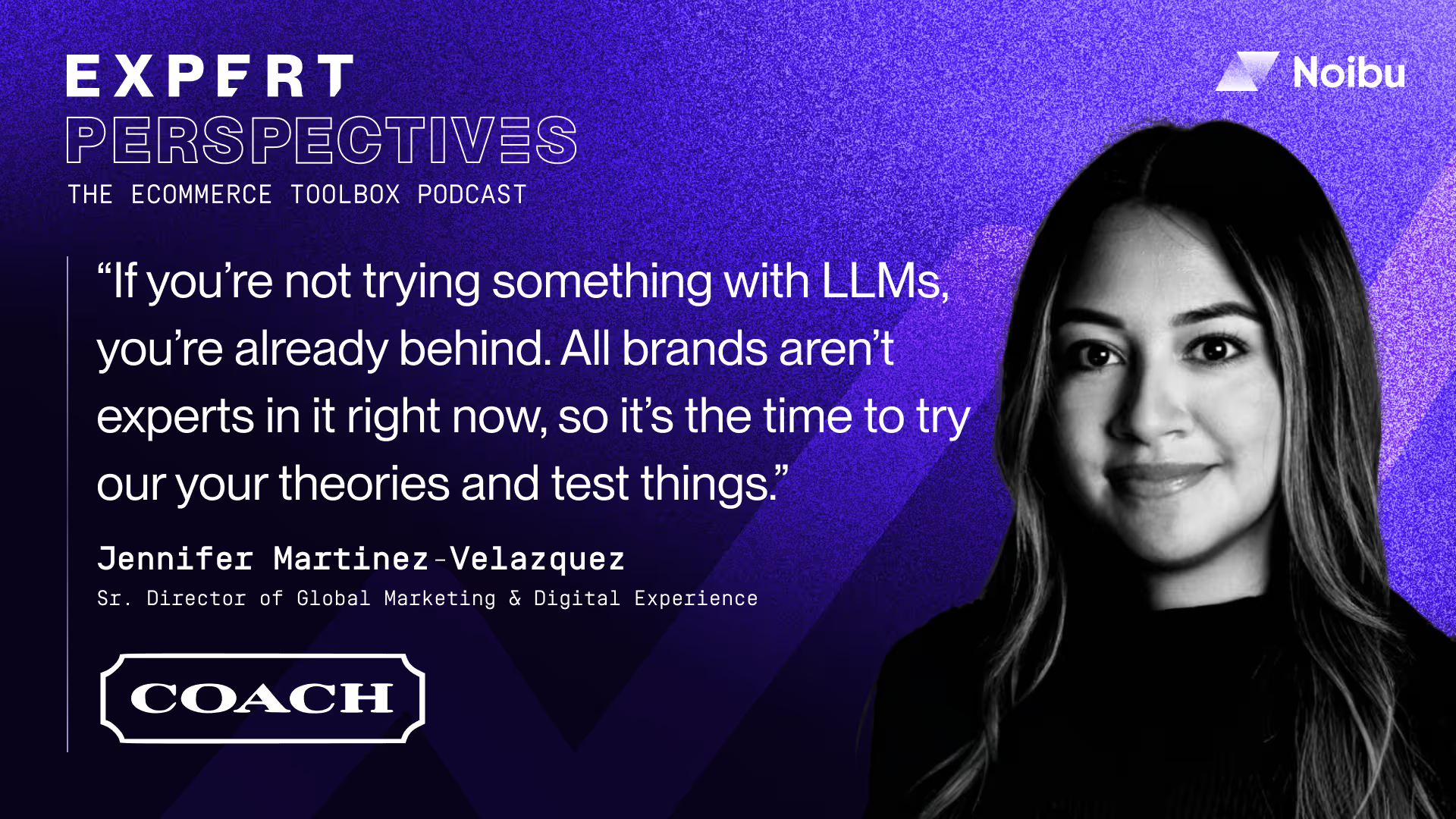
“If you’re not trying something with LLMs, you’re already behind. No brand is an expert right now — so test your theories.”
Her perspective cuts through the hype:
Jennifer also points to a critical emerging signal:
LLM-driven discovery may be small today, but users who shop through tools like ChatGPT tend to convert at significantly higher rates.
Brands that structure content around real customer questions —
“What should I wear for Valentine’s Day?” — will be best positioned as conversational search scales.
No one knows exactly how LLM data will integrate with owned ecommerce experiences. But history suggests one thing is certain:
Discovery shifts happen faster than expected.
Those who experiment early — like the brands that leaned into TikTok before it exploded — gain a durable advantage.
The bigger picture
Jennifer Martinez-Velazquez’s journey highlights what modern ecommerce leadership really requires:
The future belongs to brands that treat experience, data, performance, and storytelling as interconnected parts of the same engine.
The brands that will win are the ones that:
- Blend brand and performance seamlessly
- Build cross-functional teams fluent in both analytics and creativity
- Architect journeys around how customers actually behave
- Use AI to unlock human creativity — not replace it
- Tell consistent stories that reinforce brand value at every touchpoint
Digital transformation isn’t about more tools.
It’s about better thinking, better collaboration, and better measurement.
Want to hear Jennifer break it down herself?
Catch the full episode of The Ecommerce Toolbox: Expert Perspectives featuring Jennifer Martinez-Velazquez of Coach on your favorite podcast platform.
Listen to the full episode now
.avif)
.avif)
.avif)