
How AI is reshaping retail without killing your existing channels


Get the full episode here
Published by Noibu | The Ecommerce Toolbox: Expert Perspectives
Guest: Nitin Mangtani, SVP & GM Salesforce Commerce Cloud & Retail Cloud
Host: Kailin Noivo, Co-Founder at Noibu
🎧 Listen to the full conversation on Apple, Spotify, or YouTube
The role of the ecommerce leader is evolving at a rapid pace since the rise of mobile and marketplaces. Every major shift - search, social, mobile, marketplaces, has forced leaders to rethink how customers discover, evaluate, and buy products.
Agentic AI is the next shift. And it’s arriving faster, louder, and with more existential fear than any before it.
In this episode of The Ecommerce Toolbox: Expert Perspectives, host Kailin Noivo speaks with Nitin Mangtani, Senior Vice President and General Manager of Salesforce Commerce Cloud and Retail Cloud about what agentic AI actually means for retail leaders navigating 2025 and beyond.
Agentic commerce isn’t channel replacement – it’s a new interaction layer
Every technology wave in retail follows the same emotional arc:
New interface → existential panic → overcorrection → equilibrium.
Agentic AI will follow the same pattern.
According to Nitin, the biggest mistake brands are making is assuming that AI agents will replace ecommerce sites, stores, or apps. That framing leads to destructive decisions - underinvesting in stores, freezing site innovation, or waiting on the sidelines entirely.
Instead, agentic commerce should be understood as a new interaction layer that sits on top of existing channels - enhancing discovery, reducing friction, and accelerating decision-making.
Customers won’t “stop shopping” on websites or in stores.
They’ll arrive there better informed, more intent-driven, and more confident- because agents helped them narrow down choices before they even clicked.
The lesson for ecommerce leaders is clear:
The brands that win will integrate agentic layers into their ecosystems, not rip the ecosystem apart.
The three pillars of agent force commerce
Nitin frames agentic commerce around three distinct but connected agent types. Understanding the difference between them is critical because each drives value in a different way.
1. Shopper agents: Reinventing discovery, not checkout
For over a decade, ecommerce discovery has been constrained by search boxes, filters, and category trees. Customers think in stories and intent. Websites force them to think in keywords.
Shopper agents close that gap.
Instead of typing “black sneakers size 9,” customers can express intent:
“I want professional sneakers that work with dark jeans, are sustainable, and under $150.”
The agent responds like a great in-store associate - asking clarifying questions, learning preferences, and curating a short list of highly relevant options.
This isn’t a chatbot bolted onto PDPs. It’s conversational discovery built on deep product, inventory, and brand context.
Salesforce customers like Williams Sonoma and Pandora are already seeing:
- Higher conversion rates
- Increased basket size
- Faster decision cycles
Why this matters:
Agentic discovery changes how products must be described, structured, and merchandised. Taxonomies, attributes, and content quality suddenly matter more than ever. If your catalog isn’t agent-ready, your brand won’t surface, no matter how strong your assortment is.
Consumer behavior has already shifted from keyword search to full conversational interaction, with hundreds of millions now expecting intelligent, context-aware responses.
Once discovery becomes conversational, every industry must follow - retail included, making shopper agents a leading indicator, not a passing trend.
2. Associate agents: The fastest ROI most brands are missing
The most overlooked opportunity in agentic commerce isn’t customer-facing.
It’s employees.
Store associates and contact center agents are drowning in complexity:
- Promotions change daily
- Inventory visibility is fragmented
- Policies vary by channel
- Systems require dozens of clicks
Turnover is high not because associates don’t care but because the job is cognitively exhausting.
Associate agents flip this dynamic.
What used to take 20 clicks becomes one prompt.
Nitin calls this shift “prompts, not clicks.”
The impact is immediate:
- Faster onboarding
- Higher associate confidence
- Better customer conversations
- Higher conversion per associate
Why this matters:
If you’re only thinking about AI for customers, you’re missing the easiest productivity win in retail. Empowered associates don’t just work faster, they sell better.
3. Background agents: The quiet margin protectors
The most powerful agents never speak to customers or employees.
Background agents operate autonomously across:
- Inventory replenishment
- Demand forecasting
- Fraud detection
- Order routing
- Supply chain optimization
These agents synthesize data across systems humans can’t realistically monitor in real time. They generate recommendations, flag anomalies, and automate decisions, while keeping humans in the approval loop.
This is where real margin protection happens.
- Fewer stockouts.
- Less overbuying.
- Better working capital efficiency.
Why this matters:
Agentic commerce isn’t just a CX play. It’s an operational one. Brands that deploy background agents intelligently will quietly outperform competitors on margin, speed, and resilience, without flashy customer-facing features.
The founder lesson: Why timing and signals matter more than hype
Nitin’s perspective is grounded by experience.
At PredictSpring, he made a painful pivot, not because revenue disappeared, but because a leading indicator told him the market was shifting faster than the product roadmap. That decision saved the company and ultimately led to its acquisition.
That same discipline applies to AI today.
Agentic discovery volumes may be small right now. But conversion rates are disproportionately high. And behavior is changing faster than dashboards suggest.
Waiting for “perfect clarity” is the biggest risk. Nitin also emphasizes the importance of paying attention to customer behaviour:
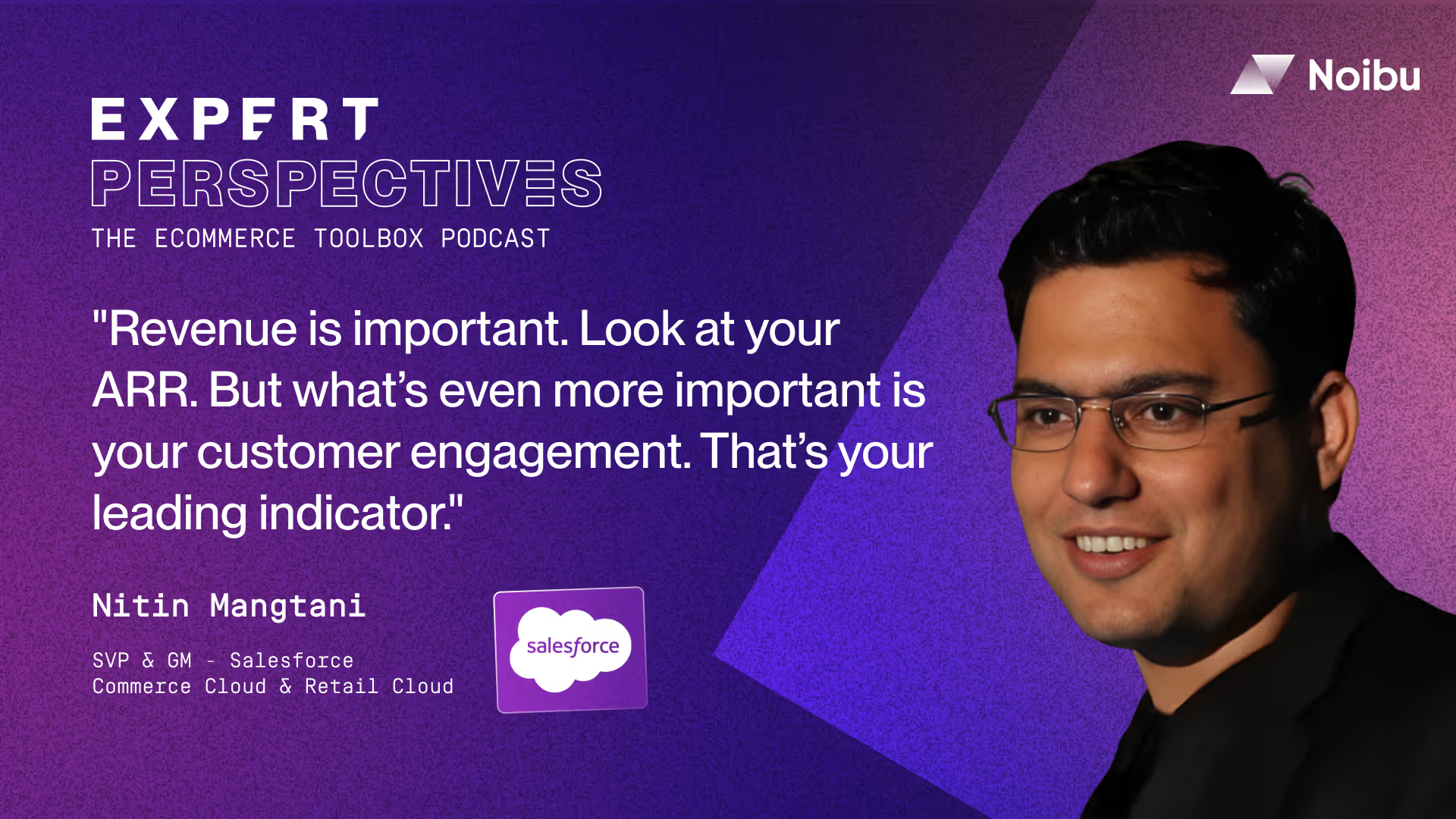
"Revenue is important. Look at your ARR. But what's even more important is your customer engagement. That's your leading indicator."
The bigger picture
Agent Force Commerce represents a shift in how retail systems think, not just how they transact.
The future of commerce will belong to brands that:
- Layer agentic intelligence onto existing channels
- Empower employees as much as customers
- Automate complexity without removing human judgment
- Prepare for new discovery models before they dominate
AI won’t kill ecommerce websites. It won’t kill stores. It won’t kill brands.
But it will expose which organizations understand how change actually works.
Want to hear Nitin Mangtani break down agentic commerce, channel evolution, and how Salesforce is thinking about the future of retail?
Catch the full episode on the Ecommerce Toolbox: Expert Perspectives on your favorite podcast platform.
Listen to the full episode now


